
Worship Guide for April 12, 2026
Like TV Guide, but from God! Find the text of the Prayers of the People and Sermon below. Use the buttons provided to find other worship materials.
During Eastertide we use this booklet.
To see the Worship Guide for other weeks, click here.
To see the Book of Common Prayer online, click here.
To donate to the Organ Fund in honor of The Reverend Mark Sutherland, click here.



Seeking Resurrection
The Reverend Linda Mackie Griggs
The Second Sunday of Easter
Year A
RCL
Sermon Audio:Will be added on Tuesday, April 14
Sermon Text:
Seeking Resurrection
Here we are, again, on “Doubting Thomas Sunday” –admit it, that’s what you were thinking–also known as Low Sunday since a lot of folks (present company excepted) give church a miss after the Easter festivities. Clergy aren’t exempt from this temptation of a lull; we are usually delighted to have a seminarian or intern preach on this day, but in absence of our friends K, Tom, and Joshua, you’re stuck with me.
Today’s Gospel story always appears in the same place in the calendar. We hear about Thomas’ doubts, right after Easter Sunday, Every. Single. Year.
You would think God was trying to tell us something through this pairing of stories. And we think we know what that is:
“Do I have enough faith?” we ask.
Good question.
What day is it?
We have days when we’re firm, and days when we’re shaken.
Days when we glory in the sunrise,
and days when we make the mistake of checking the headlines. It varies.
“Do I believe enough?”
“Have you believed because you have seen me? Blessed are those who have not seen and yet have come to believe.”
A lot of ink has been spilled regarding these parting words of Jesus to Thomas. The word, ‘chastise’ comes up in a number of commentaries. So of course we are drawn to wonder: What is Jesus telling Thomas about his faith—or lack of it?
Thomas would seem to have been portrayed forever and pejoratively as a doubter
because he was skeptical about the Resurrection. And of course by extension, we may confess that we sympathize with him. We wonder if Jesus is speaking directly to us as well as to Thomas as we make our own winding spiritual journey—
filled with questions and doubts. We wonder, do my questions and doubts disqualify me as a faithful follower of Jesus? And if unquestioning belief is the sole criterion for being a good Christian, then is there such a thing at all? (And since unquestioning uncritical belief is not a hallmark of the Anglican Tradition, this would be particularly problematic for most of us here.)
So the question persists: “Do I have enough faith?”
This story of Thomas, read Every. Single. Year, naturally draws us into the contemplation of our faith, simply because it tells a story of a man struggling with belief. So our default is to hear it as an indictment of Thomas, and of us.
But it’s important to remember that John’s Gospel was written almost a generation after the Resurrection. There was no one around who had had direct contact with Jesus or his ministry. So the writer of John’s Gospel sought to reassure an anxious community who had not experienced Jesus in person that its faith in him and his resurrection was not in vain.
So it’s not just a story a story of our faith or lack of it. It’s not just a story about what Thomas did in the story or what we do now. It’s about what God has done–and is doing.
So let’s ask a different question.
Were you ready for Easter this year?
Not everyone is. The Easter message of transformation and new life is powerful; so powerful, sometimes, that it is difficult to take it in. We just don’t always feel up to the task of embracing something as transformational, as world-changing and momentous as Resurrection. We’re not up to the rejoicing. Especially when, to be honest, the weight of the world can be overwhelming to the point that there are just not enough Alleluias to roll away the stone of our anxiety, grief, and outrage.
The truth is that there are times when we are trapped in the tomb.
Welcome to the world of Thomas, who followed the One who dared to confront the powers and principalities, the Pax Romana, whose peaceful order—so called—was enforced through instruments of violence and intimidation. Like the Cross.
What was Thomas’s truth on that first Easter?
We can only speculate as to why he was not in the house with his friends. The skepticism with which he greeted the news of Jesus’ appearance in the locked room was likely born of the trauma and grief of the preceding days.
After all that had happened, the news of resurrection was too much to take in.
He wasn’t ready for Easter; he was still in the tomb, like anyone who carries a wound or burden that distances them from Easter joy; grief, guilt, fear, cynicism, disillusionment.
Perhaps we can relate.
Sometimes, like Mary Magdalene outside the tomb or the friends on the road to Emmaeus, we can’t see Easter right in front of us.
And sometimes, like Thomas, we don’t dare look.
It is possible to be locked out in more ways than one.
But here’s the point: Whether locked out like Thomas or locked in like the disciples,
Jesus came anyway.
Right through the door.
Twice.
Interpreters over the years have focused on Thomas’ refusal to believe unless he touched Jesus’ wounds, but note that he wasn’t the only Doubting Thomas of the group. Even the rest of the disciples in the house hadn’t believed the reports of the women disciples when they breathlessly proclaimed the angel’s message. Instead they had gone into hiding, and when Jesus came through the door—literally through the door—they didn’t recognize him until they had seen the marks in his hands and side. (“Then the disciples rejoiced…”)
Did he chastise them for locking the door? No.
Did he chastise them for their fear? No.
He just said, “Peace be with you,” and in a Pentecost moment breathed the Holy Spirit upon them. And then sent them out—made them Apostles.
That’s the point of this story.
This is about what Jesus did,
not about what fear, denial, depression, or doubt did.
Here he came.
Ready or not.
And he did it twice.
And yet, having seen and rejoiced at seeing Jesus the first time—what did the disciples do? These newly inspirited Apostles shut the door again. And again it didn’t matter. Jesus came bringing words of peace. He persisted, through betrayal, death and the tomb. He persisted through the locked doors and locked hearts of his fearful friends. He never gave up on them.
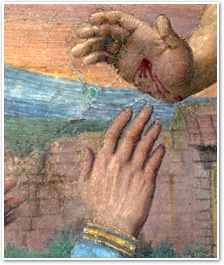
And so he offered his wounds to Thomas. Here, he says, touch. I am really here.
Thomas’s declaration of faith was instantaneous. He had said that he would not believe unless he put his hand in Jesus’ side and touched his hands and feet,
but as it turns out Jesus’ presence was all that he needed.
“My Lord and my God.”
Thomas saw Jesus’ wounds.
The disciples recognized Jesus when they recognized his wounds.
Yes, as Mark pointed out last week, Jesus was resurrected with his wounds.
As Womanist theologian Yolanda Pierce writes,
There is an intimacy to Jesus’s command to Thomas, a closeness that we cannot overlook. Christ invites him to touch the unhealed wounds—to feel the places where nails and spear had pierced his body…. Wounds, too, are a part of the divine story.
The risen Lord is not complete without brokenness, because brokenness is part of this world—a world Jesus loved to the end and loves still, even as we continue to grieve his heart and the heart of God every day.
Jesus loves us and comes to us, no matter what. No matter how many tombs we crawl into or doors we lock. That’s what he does.
That’s what God does.
We are called and challenged to seek Resurrection. To let the wounds of Jesus open our eyes to acts of hope, courage, and persistence all around us; to show up in the broken places, to witness to the world’s hurt, and even to embrace our questions and doubts and let them be the foundation of our faith—faith in what God makes possible in the face of a world that would keep us in the tomb.
Prayers of the People
The response to the bidding, “Lord, hear us,” is “Lord Graciously hear us.”
Father, we praise you for the resurrection of your Son, Jesus Christ, from the dead. Shed his glorious light on all Christian people, that we who now live in the age of the resurrection work tirelessly to advance the promise of new life for the whole world. Lord, hear us: Lord graciously hear us.
We pray for Patrick and others baptized this Easter season, and for Patrick, Ben, Hannah, Annie, and Maya to be confirmed, and for Paige and Matt to be received into the full life of the Episcopal Church next Sunday. May your whole church die and rise with Christ, through the gift of his resurrection. Lord, hear us: Lord graciously hear us.
We pray for all whom we know and love, both near and far; especially those who are celebrating birthdays this week: Mary DiSandro, Ruby Erickson, and Anna Lysynaskaya. Lord, hear us: Lord graciously hear us.
We pray for those who suffer pain and anguish, especially those who have asked for our prayers, including Bill, Brad, Sam, Carol, Arline, James, David, Tina, Larry, and those we name. Grant them encouragement to persevere – taking the outstretched hands of the risen Christ to be filled with his peace. Lord, hear us: Lord graciously hear us.
We remember before you those who have died as the victims of unjust wars in Ukraine, and the Middle East, Sudan and in other trouble spots in the world. We remember those we love but see no longer, who have died in the hope and assurance of the resurrection, especially Mary Worrell, whose life we commemorated yesterday, and in whose memory today’s flowers have been given; together with others we name. Unite us with them in your undying love. Lord, hear us: Lord graciously hear us.
Join our voices, we pray, Lord our God, to the songs of all your saints together with Mary, the God-Bearer, and Martin our patron in proclaiming the victory given us through Jesus Christ our Lord. Lord, hear us: Lord graciously hear us.