
Worship Guide for August 23, 2026
Like TV Guide, but from God! Find the text of the Prayers of the People and Sermon below. Use the buttons provided to find other worship materials.
To see the Worship Guide for other weeks, click here.
To see the Book of Common Prayer online, click here.


Dangerous
The Reverend Linda Mackie Griggs
13th Sunday After Pentecost Proper 16 Year A
Exodus 1:8-2:10
Psalm 124
Romans 12:1-8
Matthew 16:13-20
Sermon Recording:
Sermon for August 23, 2026
“But who do you say that I am?”
Jesus looks expectantly at Peter, who doesn’t miss a beat.
“You are the Messiah, the Son of the living God.”
Anointed One. Savior. Redeemer. Liberator.
That’s quite a job description. Powerful words about a powerful person. The One the prophets have foretold. The One the people of God have awaited. The One to free Israel from Roman domination and oppression.
Matthew’s Gospel portrays him as “The New Moses.”
And in today’s Old Testament lesson we begin to discover what that means.
But first, back to Jesus’ question:
Who do you say that I am?
If we were to answer that question with the same alacrity as Peter, surely we would be making a fully formed claim, not just about Jesus’ identity, but about ourselves—about the church–as well.
Wouldn’t we?
Jesus, you are the proclaimer of Good News to the poor, the marginalized, the oppressed, and the helpless. Jesus, you are the bringer of justice, the healer of the wounded, the feeder of the hungry. Jesus, you are the Messiah, the Son of the living God. And when you call, we will follow.
Won’t we?
Do we, the Body of Christ, really mean what we proclaim when we answer in unison with Peter?
Because if we do, we need to be fully open to what the Word of God is saying to us, and one of the best places to start, since Matthew portrays Jesus as the New Moses, is Exodus.
Last week we finished our reading of Genesis with the happy reunion of Joseph with his brothers and the prospect of reunion with their father Jacob. There are several chapters left in Genesis, and they are worth a read, but for our purposes the most important bit that you need to know is that in Chapter 46 God speaks directly to Jacob, reassuring him that it is okay to leave Canaan and move to Egypt to be with his sons. Why is this important? Because we have heard virtually nothing from God since the binding of Isaac many chapters earlier. God has been silent for two (long) generations.
That is about to change in a big way. Exodus. The story of slavery and liberation, of the God who hears the cries of the enslaved and oppressed and brings Pharaoh to his knees. The story of the God who calls God’s people into Covenant relationship for the healing of the world. Exodus is the key. Everything that has happened with the stories of the Patriarchs and Matriarchs in Genesis has pointed to this place, this story. And everything that happens afterward is built on this foundation.
“Then Joseph died, and all his brothers, and that whole generation. But the Israelites were
fruitful and prolific; they multiplied and grew exceedingly strong, so that the land was filled
with them.”
Joseph and his brothers were forgotten by the Egyptians over time. But as it turns out, according to theologian Kat Armas, the area where the Jacob’s descendants settled was of significance to the regime. She writes:
“Because of its proximity to Asia and because two major routes between Egypt and Syria- Palestine passed through it, Goshen served as a haven for Asiatic immigrants and a gateway through which travelers, traders, and invaders passed on their way to Egypt. This made the area strategically important for the security of Egypt. So Pharaoh [was]prompted to put pressure on the Israelites living there.”
Which perhaps illuminates the question of how, over the years, the Hebrews transformed from welcomed—or at least tolerated– refugees to despised slaves. They were Other; they did not fit into the narrative of the dominant culture except as said dominant culture needed to define and distinguish itself as not alien. As not like Them. Too many of Them. They don’t look like us. They don’t act like us. They don’t share our values. They don’t belong here. Somebody should do something about Them. The more things change, the more they stay the same. Pharaoh needed the labor of the Israelites, pushing them harder and harder, but he still feared that their numbers would at some point be turned against him. And we know that principalities do not like to release their power.
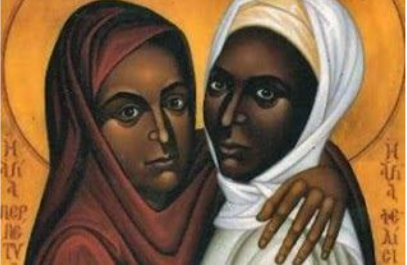
Forced labor had done nothing to reduce the number of Israelites, so Pharaoh resorted to infanticide, first by ordering midwives to kill boy babies while the mothers were still on the birthing stool. Perhaps it would delude the mothers into thinking their children were stillborn, it isn’t clear. It would not be surprising that in a patriarchal society the capacity of women to see through this clumsy subterfuge, and to resist it, was not on Pharaoh’s radar. Regardless, the midwives, Shiphrah and Puah, saved the babies by telling Pharaoh that Hebrew mothers just gave birth really fast. And Pharaoh, who left women’s matters to women, believed it and moved on to plan b. Shiphrah and Puah weren’t the only women to resist. A Levite woman concealed her beautiful son for as long as she could, and when Pharaoh said that all boy babies should be cast into the Nile, she did so, but not really. She put the baby into a basket among the bullrushes, watched over by his big sister, Miriam.
We know what happened next. Pharaoh’s daughter pulled him from the water. Miriam just happened by and mentioned that she knew of a wet nurse (the baby’s mother) who could feed him. He grew and thrived, and was adopted by Pharaoh’s daughter, who named him Moses.
And thus Exodus begins.
It begins with resistance from a place that Pharaoh never counted on; the women. All this time he was worried about the proliferation of Hebrew men, while it was the women who catalyzed Moses’ emergence as the prophet to liberate Israel. Today we see a story of subversion that comes from unexpected places, from the clever courage of two women healers to Pharaoh’s daughter’s use of her privilege to raise God’s prophet to manhood right under Pharaoh’s nose. If that’s not a sign of God’s sense of humor, I’m not sure what is. The story that begins here is a story of hope for any and all who are oppressed, marginalized, and enslaved. Throughout history it has been a foundational story of liberation, of freedom, and of a loving God who hears those who cry out for justice. Exodus is dangerous to earthly power. It has been dangerous for centuries. Why do you think American slaveholders forbade literacy for the enslaved? The powerful fear Exodus.
As well they should.
They should fear a liberating God who heard–and hears–the cries of the enslaved, the lynched, and the disenfranchised. They should fear the God who abhorred Jim Crow and urban renewal, and who continues to abhor mass incarceration, inadequate healthcare and education, crushing poverty, and driving while black. They should fear the God who weeps for the immigrant families torn apart by mass deportation; for those suffering in Alligator Alcatraz and other horrendous detention centers. They should fear the God who will feel every jolt from every pair of ICE-wielded shock gloves unleashed on each one of God’s children. Because stun guns, pepper spray, and firearms apparently aren’t enough.
And the powerful should fear the readers of Exodus who have eyes to see and ears to hear, whose hearts break for the oppressed and marginalized, and who take seriously God’s call to bring justice and healing to a world in anguish.
“Who do you say that I am?”
Saving Jesus, liberating Jesus.
How do we respond?
God does comfort the afflicted, and today, here, I expect that God also afflicts the comfortable. Jesus asked Peter a crucial question, and when Peter answered correctly, he was promptly put in charge of the Body of Christ: “And I tell you, you are Peter, and on this rock I will build my church.”
That’s us.
We are called, yes. And like Moses, we might want to ask God what God is thinking. But we are about to be nourished for the challenge and invitation of these days. Listen to the Eucharistic prayer in a few minutes: “Deliver us from the presumption of coming to this Table for solace only, and not for strength; for pardon only, and not for renewal.” This is our prayer to our liberating, loving, God.
“Who do you say that I am?”