
Worship Guide for July 12, 2026
Like TV Guide, but from God! Find the text of the Prayers of the People and Sermon below. Use the buttons provided to find other worship materials.
To see the Worship Guide for other weeks, click here.
To see the Book of Common Prayer online, click here.




The Reverend Linda Mackie Griggs
Proper 10 Year A, Pentecost 6
July 12, 2026
Genesis 25:19-34
Psalm 119:105-112
Romans 8:1-11
Matthew 13:1-9,18-23
Sermon Recording:
Any Questions?
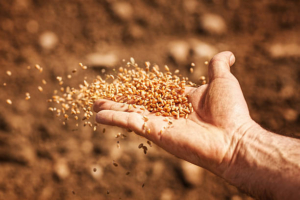
“Listen! A sower went out to sow.”
My daughter’s thumb is far, far greener than mine. When she lived in an apartment in Astoria, Queens, she had a balcony that was spacious enough to hold a bounty of potted plants. One day she noticed something unexpected. She hadn’t planted any vegetables, but there, growing in one of her pots, was a tomato plant. Where did it come from? It actually produced a single beautiful little cherry tomato that to this day we call the Immaculate Tomato.
How could I not remember this story when presented with the Parable of the Sower? It is found in all three Synoptic Gospels, and is one of just a few parables to be accompanied by an explanation. But that doesn’t make it easy. New Testament scholar Amy-Jill Levine says that if you think you understand a parable, you have more work to do. That’s really what parables are for; they want us to engage with them more than to understand them. It’s more about our questions than the answers. Curiosity, pondering, even discomfort; it is in this kind of engagement that we are formed, and even transformed, by parables.
So, let’s begin with context. The writer of Matthew’s Gospel portrayed Jesus as The New Moses, as the one who fulfills and surpasses the legacy of the great prophet who led the people of Israel out of Egypt. One of the ways Matthew did this was to structure the narrative of the Gospel around five discourses by Jesus, the number five thought to reflect the five books of the Torah. Each discourse has a different general theme, and all of them together form a loose framework for the vision of fulfillment of the Dream of God.
The First Discourse is the Sermon on the Mount, beginning with the Beatitudes; a reflection of Moses bringing the Law from Mount Sinai. The Second Discourse involves the sending and instruction of the Apostles to preach and heal. The Third Discourse is comprised of the Parables of Jesus—more on this in a minute. The Fourth Discourse is instructions about life in community, and the Fifth Discourse is about Eschatology, or the Final Days. So you can see how this structure offers a kind of rough arc of the trajectory of the Way of Love as envisioned by Matthew and the early community—the foundation, the teaching, sending, and spreading, and the final culmination of God’s Dream—the harvest, if you will.
So, back to the Third–the Parable–Discourse. The Parable of the Sower that we hear today is the first of several. Many–though not all–of them are about planting and growing and harvesting. This first one, then, is sort of an introduction to Jesus’ teaching methodology, which is borne out in the omitted section that comes between the original story and the explanation. In the bit that we don’t hear today, Jesus’s disciples ask why he teaches the people in parables, and he says, in a nutshell, that learning by puzzling things out is the best way to encounter puzzling things, and what can be more puzzling—more of a mystery—than God?
“… ‘seeing they do not perceive, and hearing they do not listen, nor do they understand.’”
According to commenter Michelle Voss Roberts, this is not necessarily a negative judgment of Jesus’ audience as much as it is an observation that understanding the God mystery is not easy—it is hard to grasp at first, and resistance is to be expected. Parables are seeds that are planted to encourage new ways of seeing, listening, and understanding—opening the heart, mind, and soul to the One who calls us to abundant life.
“Listen! A sower went out to sow.”
So the Parable of the Sower is a parable about parables. The word “parable” comes from the Greek that means, “to throw alongside”, so you can picture the action of a sower casting seeds out over the ground.
Who is the sower in this parable? Is it God, sowing grace? Is it Jesus, sowing parables? Is it us, sowing…what?
Who is the sower? What is the seed?
As we ask these questions, God is planting seeds in us.
Up until this point in his ministry, Jesus has encountered rejection, skepticism, anger, ebbing and flowing levels of devotion, and enough success to yield a number of followers and a lot of attention. As he teaches and heals and casts out demons, it could be said that he has planted his message in a lot of different soils. Like the sower in his parable he has cast wide and prodigiously. He has not focused only on the fertile ground; his message has been distributed everywhere, and he has experienced numerous challenges and obstacles. Rocks and birds, shallow ground, thorns.
Jesus is telling his followers that the work he has called them to do is filled with challenges. They need to be ready for what comes.
Who are the birds? How can you tell the shallow from fertile ground at first? Is it possible to fight the thorns, or do you just give up?
Are we the sower, the seed, or the soil?
Yes?
So many questions. The Sower keeps sowing. The seeds keep landing. Everywhere.
““Hear then the parable of the sower.”
Some commenters think that the explanation of the parable may have been from the early Christian community and not from Jesus himself. This doesn’t invalidate its meaning and significance; rather, it gives us an opportunity for an additional perspective since it reflects the later experience of the community, which included persecution by the Romans, rejection by parts of the Jewish community, wondering about the coming end times, and rapid spread and enthusiasm for the Way of Jesus.
In other words, many kinds of soil for the seeds of the Good News.
Interestingly, the explanation of the Parable of the Sower doesn’t say much about the Sower. It’s about seeds and soil.
Is it a given that the Sower is God?
Can’t there be other sowers, like us?
What might we be sowing?
What are the seeds? Or who?
Are we the seeds?
Where have we been planted?
Or wait.
Birds, shallow ground, thorns, good soil.
What are they? Evil, fear, worldly distractions, faithfulness.
Are the different soils around us, or within us?
Yes!
The soil is around and within is. And we are seeds, and sowers, and soil. It is all of that and more.
Yes.
This ‘yes’ is the gift and curse of parables. All of the images offer themselves for pondering and reflection from every possible angle. This is their invitation and their challenge to us; to enter into them through myriad doorways, and by the grace of God and the guidance of the Spirit, to reap an abundant harvest of the fruits of the Spirit.
This may sound a little as though we can read this parable without guardrails, that they can mean anything we want them to. But that’s not the case. If they don’t disturb us somehow—if they don’t form us somehow, then we have asked too little of them.
We are allowed to think outside of the box, even to question the assumptions of the parable. For example, we assume that seeds sown on rocky ground or snatched up by birds are lost to the Sower. But have you ever seen a flower sprouting up between cracks in a sidewalk, or the unexpected glory of a desert bloom after a rare shower? And what about that Immaculate Tomato—was that seed picked up by a bird from a barren path before landing on Mary Beth’s balcony? It’s interesting how good soil can be found in roundabout ways, and how Life can emerge from the most unlikely circumstances. Perhaps the Sower, in sowing generously and prodigiously, knows something about the bounteousness of grace and the persistence of the Dream of God.
Who is the sower? Is it God? Is it us?
Yes!
“Let anyone with ears, listen!”
Prayers of the People, 7 Pentecost, 12 July 2026
The response to the bidding, “Lord, in your mercy,” is “hear our prayer.”
Loving God, Guide your Church: Open our eyes to see your justice unfolding in our midst; give us courage to overcome our divisions, and faith to fulfill your call to bring Good News and healing to the world.
Lord, in your mercy, hear our prayer.
We pray for the world in its brokenness, remembering those places where war, violence, injustice and natural disaster are causing great suffering, especially in those places we name [pause]. We pray for the wisdom and will to bring peace, healing, and reconciliation to our broken world.
Lord, in your mercy, hear our prayer.
God of Justice and Mercy, we pray for our nation, for the renewal of its promise, and for those in authority, that they will serve the common good and respect the dignity of every human being. We pray for all who speak truth to power and who work to heal our divisions.
Lord, in your mercy, hear our prayer.
God of abundance, we pray for your Creation, that we might be good stewards of your bounty, living in harmony with Mother Earth and reciprocating her generosity by protecting, preserving, and restoring what She has freely given us.
Lord, in your mercy, hear our prayer.
We pray for our parish family: Be present Holy One, and bring your healing power to all who suffer in body, mind, or spirit, remembering especially, Sam, David, Rosalind, John, and those we name. [pause] Lord, in your mercy, hear our prayer.
Let your wisdom and grace rest upon those who celebrate birthdays this week, especially Berit Kosterlitz, Leanne Nyahkoon, Elijah Nyahkoon, Frank Pellegrino, Carol Tucker, and Josie Farrell-Hankins.
We pray for those we love but see no longer, especially those we name [pause]. And we pray for all who grieve. Lord, in your mercy, hear our prayer.
Celebrant adds a concluding prayer.