
Worship Guide for July 13, 2025
During June, July, we will have one service on Sundays at 9am.
Services during July and August will take place in the air-conditioned Great Hall and also online.
Like TV Guide, but from God! Find the text of the Prayers of the People and Sermon below. Use the buttons provided to find other worship materials.
To see the Worship Guide for other weeks, click here.
To see the Book of Common Prayer online, click here.




Prayers
Weekly Prayer Recording:
Prayers of the People:
Fifth Sunday after Pentecost, 13 July 2025
The response to the bidding, “Living Lord”, is “hear us.”
Lord, we ask for a spirit of courage and persistence to hold fast to the hope that is within us, in a world increasingly deaf to the values and expectations of your kingdom. Living Lord, hear us
Lord, remember our nation. In a time when violent words fan violent actions, we pray for the Congress and the courts to uphold the integrity of the Constitution and the protection of those who defend the rule of law. Living Lord, hear us
During these days when unconstitutional paramilitary intimidation is being unleashed against innocent individuals, we express our solidarity with immigrants and immigrant communities living in increasing fear. Living Lord, hear us
We pray for the Church and her life: For Sean, Presiding Bishop, and for Nicholas, our bishop; for Hosam, the Archbishop of Jerusalem; for Pope Leo; for Bartholomew, the Ecumenical Patriarch. We pray for a witness and commitment to service among all Christian leaders. Living Lord, hear us
In a world of increasingly pressing needs, we ask you to forgive our silent complicity in the war crimes being perpetrated upon the helpless people of Gaza and the ethnic cleansing of Palestinian communities in the West Bank. We pray for peace with justice to come to the Middle East.
We continue to pray for a negotiated peace in Ukraine that honors a commitment to Ukrainian sovereignty and future self-determination.
We pray for an end to the civil wars in Sudan, Yemen, and Myanmar. For all forced to flee from their homes and homelands by the violence of war and threats to life and livelihood. Living Lord, hear us.
We remember the Earth and the threat of climate change, praying for the strengthening of emergency services and necessary infrastructure to meet the challenge of climate instability. At the beginning of a predicted summer worsening of climate turbulence, we remember communities in the path of wind, fire, and flood, especially those affected by the flooding in Central Texas. Living Lord, hear us.
We pray for all in need and in trouble: for those whose strength is failing through ill health; whose spirits are flagging through depression; whose determination is being sapped through addiction; that they might know God’s comforting presence and healing. Living Lord, hear us.
We remember with love those who have asked for our solidarity in prayer: Mary, Sam, Benjamin, Stefan, Randall, Iris, Dan, and Lexi; for the patients and the striking workers at Butler Hospital, and others we name]. Living Lord, hear us
We pray for our own needs, as well as those of those nearest and dearest to us, remembering especially those celebrating birthdays this week: Elijah Nyahkoon, Frank Pellegrino, and Carol Tucker.
Living Lord, hear us
Surrounded by so great a cloud of witnesses, we remember those we love but see no longer, especially Margaret MacDonald, wife of Ian, and those we name. And we pray for all who grieve. Living Lord, hear us.
Celebrant adds a concluding prayer.
Neighbor problems
The Reverend Mark Sutherland
Fifth Sunday after Pentecost
Proper 10
In his recent WAVES Festival address in San Diego – WAVES being an acronym for Well-being, Art, Vision, Entrepreneurship, and Science- David Brooks offered a commentary on current America, referring to the country having taken two recent hits. He described the Zelensky meeting in the Oval Office as a searing memory. What I saw that day was a group of people who occupied the Oval Office seeking power – just pure power – the power to bully. The Oval Office event reminded Brooks of George Orwell’s 1984, in which one of Orwell’s characters describes his lust for power being fulfilled not as a demand for obedience, but in the capacity to make other people suffer. It seems clear that Brooks’ number one hit on the nation concerns the Administration’s driving impulse – to achieve absolute power confirmed by its capacity to inflict suffering and embrace cruelty as a primary instrument of routine government.
In his address, Brooks suggests that American society moves through repetitive historical cycles – his point being that no matter how bad things currently seem, we’ve been here at least once before in the amazingly short 250-year history of the American experience. While identifying several socio-political elements in the repeating historical cycle, as his second hit on the nation he identifies the dramatic shift in the politics of immigration.
He notes that the idea of America is that we welcome all sorts of people here, and we celebrate diversity and pluralism. America is a crossroads nation where people come and bring their talents, and they have the opportunity to grow and contribute to the creation of a national sense of confidence. He noted that the current political climate is the result of a cataclysmic loss of [national] confidence and some sort of spiritual assault.
In Luke 10, the lawyer initiates a conversation with Jesus about the inheritance of eternal life. We detect a quality of self-serving in his approach. Fixing him with a shrewd and assessing gaze, Jesus flushes out the man’s real concerns. It’s not his capacity to love God that’s on the lawyer’s mind, but the thorny requirement to love his neighbor as himself. He blurts out – Who is my neighbor? As is his custom, Jesus does not try to explain. Instead, he tells him a story.
As I often remind us, the construction and telling of stories provides the only lens through which we can view and make some sense of our experience and place in the world. In his address to the WAVE Festival, Brooks is reminding us that we have always had competing stories through which to discover and articulate our experience as a nation. In any period, the rise and fall of particular stories color our view of ourselves as a nation. This is so clearly demonstrated in the cyclic pattern of our attitudes to the concept of neighbor. Is a neighbor someone like us or not like us, someone to be welcomed, if only out of a sense of self-interest, or feared? Each answer will determine national immigration policy.
Brooks identifies national confidence as a key ingredient of whether we embrace an inclusive or exclusive story of neighbor. He quotes John Bowlby the great British psychoanalyst and originator of attachment theory who wrote that all of life is a series of daring explorations from a secure base – all of life is a series of daring explorations from a secure base. Brooks argues that recent history has robbed Americans individually and collectively of a sense of living life from a secure base. Fear and insecurity have come to characterize the current state of national confidence. Since the financial collapse in 2008, ordinary Americans have experienced one blow after another to our confidence. Our insecurity, now both everyday as well as existential feeds a pathological suspicion of our neighbor. Like the lawyer confronting Jesus, we are currently experiencing a deep anxiety concerning personal and collective obligations towards our neighbor, the biblical stranger in our midst.
We find ourselves in periods when our national confidence allows us to welcome immigrants as an untapped resource contributing to our shared prosperity through high-value knowledge and skills or filling the multitude of jobs we no longer wish to or lack sufficient people to perform. There are other periods, such as the one we are currently slogging our weary way through, when, sapped by loss of personal and national confidence, we fall prey to the story casting immigrants as threats to our very way of life. From history, even our short 250-year national history, we can chart which of those competing stories has the power to liberate and which to imprison – to take us forward or cast us back. I suppose the light at the end of the tunnel is the knowledge that we have been here before, and we eventually come through periods of fear and insecurity to embrace a brighter story of ourselves.
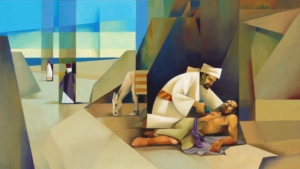
Because we are somewhat biblically educated Episcopalians, we are aware of some of the historical cultural tensions and clashes of identity in Jesus’ parable of the Good Samaritan. For a start, we remember that Jews and Samaritans hated each other – a hatred rooted in the tragedy and pain of a shared history. Between Jew and Samaritan existed a hatred and fear of a ferocity equaled by the current Israeli Palestinian mutual fear and loathing. Good Samaritan for Jesus’ hearers was a shocking and provocative oxymoron – a rhetorical figure of speech in which deeply incongruous and contradictory terms are combined. Such is Jesus’ way.
At the heart of the lawyer’s conversation with Jesus lies his need to have Jesus limit his obligation to love his neighbor as himself. His need was rooted in his fear of too much being asked of him – in other words, he lacked the self-confidence to receive the commandment. Jesus recognizes this, and so at the end of his provocative story, he asks who in the story was the neighbor to the robbed and beaten man? Without thinking, the lawyer blurts out, the one who showed him mercy.
The obligation to show mercy suddenly jumps out of the parable and hits the lawyer fair and square in the face. Mercy emerges as the heart of what it means to love our neighbor as ourselves.
The concept of love is always ambiguous. We can quibble over the extent or limit of what it means to show love for our neighbor. But the command to show mercy allows for no such ambiguity. Perhaps this is why, in the current political climate, mercy has become the most provocative and incendiary of all the expectations of the kingdom.
Image: by Jorge Cocco
In his recent WAVES Festival address in San Diego – WAVES being an acronym for Well-being, Art, Vision, Entrepreneurship, and Science- David Brooks offered a commentary on current America, referring to the country having taken two recent hits. He described the Zelensky meeting in the Oval Office as a searing memory. What I saw that day was a group of people who occupied the Oval Office seeking power – just pure power – the power to bully. The Oval Office event reminded Brooks of George Orwell’s 1984, in which one of Orwell’s characters describes his lust for power being fulfilled not as a demand for obedience, but in the capacity to make other people suffer. It seems clear that Brooks’ number one hit on the nation concerns the Administration’s driving impulse – to achieve absolute power confirmed by its capacity to inflict suffering and embrace cruelty as a primary instrument of routine government.
In his address, Brooks suggests that American society moves through repetitive historical cycles – his point being that no matter how bad things currently seem, we’ve been here at least once before in the amazingly short 250-year history of the American experience. While identifying several socio-political elements in the repeating historical cycle, as his second hit on the nation he identifies the dramatic shift in the politics of immigration.
He notes that the idea of America is that we welcome all sorts of people here, and we celebrate diversity and pluralism. America is a crossroads nation where people come and bring their talents, and they have the opportunity to grow and contribute to the creation of a national sense of confidence. He noted that the current political climate is the result of a cataclysmic loss of [national] confidence and some sort of spiritual assault.
In Luke 10, the lawyer initiates a conversation with Jesus about the inheritance of eternal life. We detect a quality of self-serving in his approach. Fixing him with a shrewd and assessing gaze, Jesus flushes out the man’s real concerns. It’s not his capacity to love God that’s on the lawyer’s mind, but the thorny requirement to love his neighbor as himself. He blurts out – Who is my neighbor? As is his custom, Jesus does not try to explain. Instead, he tells him a story.
As I often remind us, the construction and telling of stories provides the only lens through which we can view and make some sense of our experience and place in the world. In his address to the WAVE Festival, Brooks is reminding us that we have always had competing stories through which to discover and articulate our experience as a nation. In any period, the rise and fall of particular stories color our view of ourselves as a nation. This is so clearly demonstrated in the cyclic pattern of our attitudes to the concept of neighbor. Is a neighbor someone like us or not like us, someone to be welcomed, if only out of a sense of self-interest, or feared? Each answer will determine national immigration policy.
Brooks identifies national confidence as a key ingredient of whether we embrace an inclusive or exclusive story of neighbor. He quotes John Bowlby the great British psychoanalyst and originator of attachment theory who wrote that all of life is a series of daring explorations from a secure base – all of life is a series of daring explorations from a secure base. Brooks argues that recent history has robbed Americans individually and collectively of a sense of living life from a secure base. Fear and insecurity have come to characterize the current state of national confidence. Since the financial collapse in 2008, ordinary Americans have experienced one blow after another to our confidence. Our insecurity, now both everyday as well as existential feeds a pathological suspicion of our neighbor. Like the lawyer confronting Jesus, we are currently experiencing a deep anxiety concerning personal and collective obligations towards our neighbor, the biblical stranger in our midst.
We find ourselves in periods when our national confidence allows us to welcome immigrants as an untapped resource contributing to our shared prosperity through high-value knowledge and skills or filling the multitude of jobs we no longer wish to or lack sufficient people to perform. There are other periods, such as the one we are currently slogging our weary way through, when, sapped by loss of personal and national confidence, we fall prey to the story casting immigrants as threats to our very way of life. From history, even our short 250-year national history, we can chart which of those competing stories has the power to liberate and which to imprison – to take us forward or cast us back. I suppose the light at the end of the tunnel is the knowledge that we have been here before, and we eventually come through periods of fear and insecurity to embrace a brighter story of ourselves.
Because we are somewhat biblically educated Episcopalians, we are aware of some of the historical cultural tensions and clashes of identity in Jesus’ parable of the Good Samaritan. For a start, we remember that Jews and Samaritans hated each other – a hatred rooted in the tragedy and pain of a shared history. Between Jew and Samaritan existed a hatred and fear of a ferocity equaled by the current Israeli Palestinian mutual fear and loathing. Good Samaritan for Jesus’ hearers was a shocking and provocative oxymoron – a rhetorical figure of speech in which deeply incongruous and contradictory terms are combined. Such is Jesus’ way.
At the heart of the lawyer’s conversation with Jesus lies his need to have Jesus limit his obligation to love his neighbor as himself. His need was rooted in his fear of too much being asked of him – in other words, he lacked the self-confidence to receive the commandment. Jesus recognizes this, and so at the end of his provocative story, he asks who in the story was the neighbor to the robbed and beaten man? Without thinking, the lawyer blurts out, the one who showed him mercy.
The obligation to show mercy suddenly jumps out of the parable and hits the lawyer fair and square in the face. Mercy emerges as the heart of what it means to love our neighbor as ourselves.
The concept of love is always ambiguous. We can quibble over the extent or limit of what it means to show love for our neighbor. But the command to show mercy allows for no such ambiguity. Perhaps this is why, in the current political climate, mercy has become the most provocative and incendiary of all the expectations of the kingdom.