
Worship Guide for July 19, 2026
Like TV Guide, but from God! Find the text of the Prayers of the People and Sermon below. Use the buttons provided to find other worship materials.
To see the Worship Guide for other weeks, click here.
To see the Book of Common Prayer online, click here.


The Reverend Linda Mackie Griggs
19 July 2026
Pentecost 9 Proper 12 Year A
Genesis 28: 10-19a
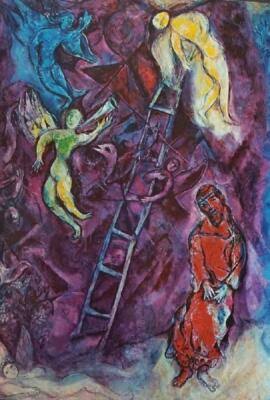
Image: Chagall’s Jacob’s Dream
Sermon Recording:
To Know and to Be Known
“How awesome is this place! This is none other than the house of God, and this is the gate of heaven.”
Barry Lopez was an essayist and nature writer known for, among other works, Arctic Dreams, which won the National Book Award in 1986. In a selection from a posthumous collection of his essays, Lopez wrote about the importance of deep human connection with place, particularly natural landscapes. He wrote:
“The determination to know a particular place, in my experience, is consistently rewarded. And every natural place, to my mind, is open to being known. And somewhere in this process a person begins to sense that they themselves are becoming known, so that when they are absent from that place they know that place misses them. And this reciprocity, to know and be known, reinforces a sense that one is necessary in the world.”
It is in this context of landscape and healing that we read today’s Genesis story, in which the word, “place” appears six times.
So how has Jacob come to this place?
“Jacob left Beer-sheba and went toward Haran.”
Jacob didn’t just “leave”. He was exiled.
Perhaps this doesn’t come as a surprise. One of the meanings of Jacob’s name is “supplanter.” As we heard last week, he conned his brother Esau out of his birthright for a bowl of red lentil stew. Later, in the story just before today’s passage, Jacob’s father Isaac had become very old and almost blind, and his wife Rebekah persuaded her favorite son Jacob to disguise himself as hairy Esau by covering his face and hands with goatskin and cooking an array of meaty delicacies for his father, who (after some suspicious hesitation) bestowed his blessing upon the younger, rather than the elder, brother. When the deception was revealed, Esau plaintively cried out, “Have you only one blessing, Father? Bless me, me also, Father!” But soon his devastation gave way to rage, and Esau swore to kill Jacob for what he had done to him.
So Rebekah sent her boy away:
“Now therefore, my son, obey my voice; flee at once to my brother Laban in Haran, and stay with him a while, until your brother’s fury turns away…”
And so Jacob leaves. Does he know of God’s Promise to his grandfather Abraham that his heirs would be as numerous as the stars in the sky? Does Jacob know of the oracle to Rebekah that his progeny would be a nation that would be stronger than his brother’s, “…the elder shall serve the younger”? We can only speculate. What we do know is that, in this moment, having arrived at this unknown place between Beer-sheba and Haran, Jacob is alone, afraid, without resources, without family support, with an uncertain future, and nothing but a rock for a pillow. Jacob is effectively no one, in no place.
He sleeps.
He dreams.
In his dream God comes and stands beside him as angels proceed up and down a ladder in front of him. Interpreters have proposed that this is not a conventional ladder so much as a Mesopotamian-style earthen ziggurat reaching skyward, with divine messengers moving up and down its ramps. Thus Jacob witnesses the extraordinary sight of the joining of earth to heaven and heaven to earth, with God completely present beside him.
This wasn’t just a vision of God. It was God, bearing a new version of the Promise; this one two-fold:
“…the land on which you lie I will give to you and to your offspring…and you shall spread abroad to the west and to the east and to the north and to the south; and all the families of the earth shall be blessed in you and in your offspring.”
Land. A legacy of offspring. A future. This was the blessing to Jacob’s family, reflecting the earlier promise to Abraham and Isaac. And there’s more:
“Know that I am with you and will keep you wherever you go, and will bring you back to this land; for I will not leave you until I have done what I have promised you.”
This part of the Promise is personal: “Jacob, I will be with you, and I will protect you, and I will bring you home again.”
“Surely the Lord is in this place—and I did not know it!”
Jacob awakens as a new person, with a renewed Promise. Claimed by God, by this place.
Is it any wonder that Jacob would want to memorialize this place and this moment? He creates a kind of cairn and anoints it, naming it Bethel, House of God.
What does it mean to mark a place in this way?
What is the gift?
What is the curse?
The gift lies in the human capacity for awe woven with God’s and Creation’s capacity to inspire it; the way we are wired to know and respond to the liminal, the “thin places” where divine and earthly meet. When we encounter them, we feel it in our core, and they become fixed in our memory. Perhaps you know of a place like that. Barry Lopez would say that if we slow down enough–if we become completely present in such a way that we are not thinking of what comes next, the landscape is ever-open to reciprocating and rewarding our attention.
“…to know and be known…a sense that one is necessary in the world.”
You can see how this is an opportunity for healing—if we allow ourselves to be drawn into relationship with the world around us in a mutual way—as we say in the Prayers of the People, living in harmony with Mother Earth and reciprocating her generosity—this can transform our perspective of our fellow creatures, both human and non-human, seeing them not as outsiders but as neighbors—all bearing the Christ image.
But there is another side to the story of Jacob’s pillar at Bethel. What happens when the marking of a place as sacred becomes a claim of ownership, a planting of the flag? When the place is no longer a gate to the divine, but an idol reserved only for those deemed worthy?
This is a tragic reading of God’s Promise to Jacob:
“…the land on which you lie I will give to you and to your offspring; and your offspring shall be like the dust of the earth, and you shall spread abroad to the west and to the east and to the north and to the south…”
Ask the victims of the first and second Nakba—the expulsions of the Palestinians from their homeland in 1948 and since 2023—ask if they feel that Jacob’s awe in that moment was an invitation to them, or if it has been perverted into a door slammed shut.
The curse comes when the Creation’s claim upon us is turned into the mistaken conviction that we have a right to claim Creation as possession, as something we—and only a certain we– can own for ourselves, even if to the detriment of anyone who is not we.
Additionally, the Administration’s attempt to reduce the size of Bears Ears and Grand Staircase National Monuments in Utah to less than ten percent of their original size, making nearly three million acres available for drilling, mining, and development and threatening wildlife and irreplaceable archeological sites important to Native tribes, is another example of the of what happens when we see Creation as an object for use rather than a neighbor to be cherished. When these liminal spaces, these houses of God, are gone, they are gone. This is not partnership, it is enslavement of one deemed, not neighbor, but Other.
One could argue that Scripture puts humans at the top of Creation, but in recent years a Creation-centered lens on Scripture has evolved of necessity because we have neglected our responsibility to what God has so freely given. So stewardship has come to mean not just how we use resources, but how we live in harmony and reciprocity with all living things as fellow children of God.
Imagine Jacob waking up that morning–to the sunrise, the birdsong, the quiet, the gentle breeze. Imagine Jacob awakening to this landscape–his dream still lingering—awakening to the awe of knowing this place, and being known by it. No longer alone. “Necessary to the world.”
“…This is none other than the house of God, and this is the gate of heaven.”
Imagine. Is God calling us to wake up too?
Prayers of the People, 8 Pentecost, 19 July 2026
The response to the bidding, “Lord, in your mercy,” is “hear our prayer.”
Loving God, guide your Church: Inspire us to be the wellspring of hope for all people; refine and perfect it so that we may be a conduit for your love and mercy. Lord, in your mercy, hear our prayer.
We pray for the world in its brokenness, remembering those places where war, violence, injustice and natural disaster are causing great suffering, especially in those places we name [pause]. We pray for the wisdom and will to bring peace, healing, and reconciliation to our broken world.
Lord, in your mercy, hear our prayer.
God of Justice, we pray for our nation: Come and dwell in the hearts of all in authority; lead them to desire peace and to serve the common good, that we might fully live into our liberty and be a beacon of hope to the world.
Lord, in your mercy, hear our prayer.
God of abundance, we pray for your Creation, that we might be good stewards of your bounty, living in harmony with Mother Earth and reciprocating her generosity by protecting, preserving, and restoring what She has freely given us.
Lord, in your mercy, hear our prayer.
We pray for our parish family: Be present Holy One, and bring your healing power to all who suffer in body, mind, or spirit, remembering especially, Sam, David, Karen, John, Katie, Mary Jane, and those we name. [pause]
Lord, in your mercy, hear our prayer.
Let your wisdom and grace rest upon those who celebrate birthdays this week, especially Alex Potter, Ray Lavoie, and Zech Chafee.
We pray for those we love but see no longer, especially those we name [pause]. And we pray for all who grieve. Lord, in your mercy, hear our prayer.
Celebrant adds a concluding prayer.