
Worship Guide for July 20, 2025
During June, July, and August, we will have one service on Sundays at 9am.
Services during July and August will take place in the air-conditioned Great Hall and also online.
Like TV Guide, but from God! Find the text of the Prayers of the People and Sermon below. Use the buttons provided to find other worship materials.
To see the Worship Guide for other weeks, click here.
To see the Book of Common Prayer online, click here.




Prayers
Weekly Prayer Recording:
Prayers of the People:
Sixth Sunday after Pentecost, 20 July 2025
The response to the bidding, “Living Lord”, is “hear us.”
Lord, we ask for a spirit of courage and persistence to hold fast to the hope that is within us, in a world increasingly deaf to the values and expectations of your kingdom. Living Lord, hear us
Lord, remember our nation. In a time when violent words fan violent actions, we pray for the Congress and the courts to uphold the integrity of the Constitution and the protection of those who defend the rule of law. Living Lord, hear us
During these days when unconstitutional paramilitary intimidation is being unleashed against innocent individuals, we express our solidarity with immigrants and immigrant communities living in increasing fear. Living Lord, hear us
We pray for the Church and her life: For Sean, Presiding Bishop, and for Nicholas, our bishop; for Hosam, the Archbishop of Jerusalem; for Pope Leo; for Bartholomew, the Ecumenical Patriarch. We pray for a witness and commitment to service among all Christian leaders. Living Lord, hear us
In a world of increasingly pressing needs, we ask you to forgive our silent complicity in the war crimes being perpetrated upon the helpless people of Gaza and the ethnic cleansing of Palestinian communities in the West Bank. We pray for peace with justice to come to the Middle East.
We continue to pray for a negotiated peace in Ukraine that honors a commitment to Ukrainian sovereignty and future self-determination.
We pray for an end to the civil wars in Sudan, Yemen, and Myanmar. For all forced to flee from their homes and homelands by the violence of war and threats to life and livelihood. Living Lord, hear us.
We remember the Earth and the threat of climate change, praying for the strengthening of emergency services and necessary infrastructure to meet the challenge of climate instability. With worsening climate turbulence this summer, we remember communities in the path of wind, fire, and flood, especially those affected by the flooding in Central Texas. Living Lord, hear us.
We pray for all in need and in trouble: for those whose strength is failing through ill health; whose spirits are flagging through depression; whose determination is being sapped through addiction; that they might know God’s comforting presence and healing. Living Lord, hear us.
We remember with love those who have asked for our solidarity in prayer: Sam, Stefan, Lexi, Mary, Hal and Beth; for the patients and the striking workers at Butler Hospital, and others we name.
Living Lord, hear us
We pray for our own needs, as well as those of those nearest and dearest to us, remembering especially those celebrating birthdays this week: Ray Lavoie, Beth Donahue, Zech Chafee, Sam Coale, and Peter Allen. Living Lord, hear us
Surrounded by so great a cloud of witnesses, we remember those we love but see no longer, especially those we name. And we pray for all who grieve. Living Lord, hear us.
Conflictual Motivations
The Reverend Mark Sutherland
Sixth Sunday after Pentecost
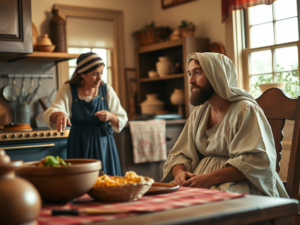
Today’s Gospel reading tells the story of Jesus’ visit to the house of Martha and Mary, as recounted by Luke. I have to say my first reaction to seeing this as the gospel for the day drew a weary yawn from me – oh no, not this old chestnut again. For me, the old chestnut is the well-worn trope -better to be a passive hearer of the word than an active doer. I didn’t have to dig too deeply to realize that my response was a self-justification. When I go a little deeper, I experience this story of Luke’s as a judgment of one of my prominent personality characteristics.
I’m a potterer. My new best friend, Chat GPT, defines potterer as: a person who occupies themselves by doing small tasks in a leisurely, casual, or aimless manner. They spend their time doing small activities around the home or garden without any urgency or particular purpose. Ouch!
When Al and I came to Providence, we bought a 200-year-old colonial house with many small rooms. Having spent the greater part of our lives together in flats or condos designed around integrated kitchen-living-dining spaces, living in a house with many small rooms did not really suit us. But the one gift of such a house for me was that there was always something that needed doing, fixing, changing. As many of you may know, 200-year-old houses provide a marvelous excuse to potter.
We’ve since returned to condo living. However, one drawback to the integrated kitchen-living-dining space is that my need to potter around becomes a major source of irritation to my spouse.
At 6 pm most evenings, Al and I stop and sit down together to watch the PBS NewsHour. 6 pm coincides with cocktail hour, which for me at the moment means a refreshing glass of chilled Fino Sherry. As I approach my advancing years, I find myself returning to the satisfaction of this most quintessentially English aperitif.
But if you think I’m painting a picture of two aging clerics quietly sitting down to watch the evening news, you would be wrong. I start out sitting, but because the TV is always visible in our integrated space, I soon start wandering back and forth between pottering in the kitchen and sitting still, driving Al to eventually say – For heaven’s sake, sit down – before in exasperation, asking – Is there any need for you to be in the kitchen? No need, I reply, just trying to be helpful.
The major problem with pottering is captured in T.S. Eliot’s words from the first part of his Choruses from the Rock –
The endless cycle of idea and action, endless invention, endless experiment, brings knowledge of motion, but not of stillness; knowledge of speech, but not of silence; …Where is the Life we have lost in living?
I enjoy being busy with small activities that lack urgency and a particular purpose. In other words, I am continually in a state of distraction. Distraction from free-floating existential anxieties causes me to miss so much of what life has to offer – life lost in the living.
In the story of Jesus’ visit to the home of his friends Martha and Mary, we are being offered three key insights. Firstly, the story offers us a glimpse of the importance to Jesus of friendship. He was more than an itinerant holy man wandering to and fro, accompanied only by a band of followers obsessed by a mission. Jesus seems to have had room in his life for familial friendships. We can imagine that he returned to Martha and Mary’s home in Bethany whenever he was passing through the area, as further evidenced by John’s story of another visit made to Martha, Mary, and their brother Lazarus, in the tumultuous days before his final week in Jerusalem. How many times do we miss the moment offered to us in friendships because we are too distracted, preoccupied with other things?
Secondly, Luke introduces us to the difference between Martha and Mary’s welcome. While Martha is preoccupied with the duties of playing the host, Mary sits quietly at Jesus’ feet, receptive to his words.
Luke describes Martha as a woman distracted by many things. He very deliberately uses the word perispaō which carries a rich meaning of being pulled away, to be dragged around, to be overburdened or drawn in different directions. Martha is overburdened by her distraction, which diverts her attention away from what really matters in this moment. The issue isn’t Martha’s host responsibilities—it’s her attitude of busyness. Martha wants Jesus to feel welcomed as the family’s honored guest and longtime friend. But pay attention to what her approach to this is doing to her. Her joy at Jesus’s arrival is tainted with resentment about all she has to do – Lord do you not care that my sister has left me to do all the work?
The third insight in this story for us lies in remembering that Luke is the most woman-friendly of the New Testament writers. He uses his story of Jesus’ visit to Martha and Mary to make a countercultural point. In taking on the role of a disciple and sitting at the Lord’s feet, attentive to his words, Mary’s action would have shocked a first-century Jewish audience, where such a privilege was reserved only for men. By contrast, Martha seems resentfully resigned to fulfill the more conventional expectations of a good 1st-century Jewish hostess.
Luke’s story of Jesus’ visit to old friends is a theological story about the nature of discipleship. All disciples are good people, but not all good people are disciples is the theological message Luke wants to get across. He contrasts Christian discipleship with what I would call being a good person, doing what a good person does. Now we all agree that doing good is preferable to doing harm, but where does the source of our motivation to make a difference in the world come from? In other words, are we motivated by our need to project self-image? I’m kind, I’m generous, I’m concerned about others because this is who I am. Or are we motivated to do good because we are motivated by a sense of being part of something so much greater than ourselves –namely a participant in the mission Jesus began but now entrusts us to continue.
You may ask – am I not just splitting hairs? Why does the source of our motivation to do good matter, so long as our actions achieve a good result? Luke would answer, simply pay attention to the personal effect of the difference in Martha’s and Mary’s responses to Jesus.
Discipleship begins not with doing for, but with attending to, Jesus. Jesus doesn’t say Martha’s work is wrong. He says she’s missing the one thing necessary.
Are we not all Martha? Distracted. Pressured. Measuring our value by what we can accomplish—even in ministry. But Jesus invites us to slow down and metaphorically sit at his feet. We are a community where the primary impulse is often to serve as a projection of our need to be effective. How quickly this compulsion can turn to, if not resentment, then to fatigue when things don’t go the way we expect.
When the source of motivation is a desire for a successful outcome, the danger of disappointment lurks in the shadows. However, when the actions we take flow from a faith-filled vision of discipleship, we cannot feel daunted because we understand ourselves to be conduits through which the greater expectations of the kingdom are being realized, regardless of how things may appear to us. Not my will but thine, O Lord.
We must guard against our need to be do-gooders if being of use, making a difference, is to be a fruit of discipleship and not just a projection of our own sense of self as a good person. Christian-inspired action flows out of our desire not to act but to listen and receive Jesus through stillness. Anglican Tradition – with its emphasis on the centrality of common worship offers frequent opportunities to encounter Jesus in the collective stillness of hearing his Word and being fed by his body and blood. This is the essential prerequisite, only after which can we go out with confidence to love and serve the Lord.
Luke uses this brief narrative to emphasize that listening to Jesus—receiving his teaching—is the heart of true discipleship. This story is less about contrasting personalities (active vs. contemplative) and more about what matters most in the life of a follower of Christ.
Questions to ask ourselves:
-
- Do I value Jesus’ voice above my own productivity?
-
- Have I confused good works with spiritual depth?
-
- When was the last time I sat still and really listened?
Martha’s service isn’t wrong, but in that moment, it’s conflictual. She is trying to serve Jesus without first receiving from him. Her motivation is shaped by her conventional understanding of what’s required of her. Her impulse comes from both self and societal expectations, rather than from faith. Consequently, her good intentions leave her feeling burdened and resentful.
Mary wasn’t lazy—she was focused. She wasn’t passive—she was present, allowing herself to be shaped by her encounter with Jesus’ Word before embarking on the life of faith in action. How very countercultural.