
Worship Guide for June 6, 2026
Like TV Guide, but from God! Find the text of the Prayers of the People and Sermon below. Use the buttons provided to find other worship materials.
To see the Worship Guide for other weeks, click here.
To see the Book of Common Prayer online, click here.



Speak.
The Reverend Linda Mackie Griggs
Pentecost 2 Proper 5 Year A
7 June 2026
- Matthew 9:9-13, 18-26
- Luke 1: 39-55
Sermon Audio:
Sermon Text:
Speak.
Holy One, may the words of my mouth and the meditations of all of our hearts be acceptable in your sight, Amen.
“Ordinary Time.”
That’s what the Church calls the weeks/months from now until Advent.
“Ordinary.”
Do the times we are living through look ordinary to you?
Setting that question aside for a moment, let’s look more closely at what the Church means by Ordinary Time. From a practical standpoint it’s a place in the Liturgical Calendar between the major seasons of the church year like Advent, Lent, and Easter. But the Church also asks us to use this time for a particular purpose; to become more deeply immersed in how we are called to live out our faith and the meaning of the Resurrection in our ordinary life.
In other words, now that we have experienced Christmas, Epiphany, Easter, Pentecost, and Trinity, how do we reflect and embody those experiences, not only with our lips, but in our lives?
Ordinary Time isn’t a liturgical vacation.
It’s boot camp.
Which brings me back to the original question.
Do the times we’re living through look ordinary to you?
The Christian Century has an entire series of articles “Mourning the state of voting rights.”
The New York Times story this week: “Hegseth removes female and Black Navy officers from promotion list.”
The Atlantic cover story this month is “The Men Who Don’t Want Women to Vote. Or work. Or have opinions.”
And this from WABC News: “Tennessee Declares June ‘Nuclear Family Month’ Instead of Pride Month.”
Sadly, this is part of the human story since the beginning: Two steps forward, three steps back. Our Baptismal Covenant calls us to work for justice and peace, seek and serve Christ in all persons and to respect the dignity of every human being. Yet God’s heart must be breaking at the myriad new ways we keep discovering to demean, dismiss, and erase one another:
Where people of color and queer persons are increasingly marginalized, disenfranchised, and endangered.
Where men in authority are judged whether they have high testosterone (good) or if they are “feminized” (bad).
Where women are…silenced. According to the Atlantic story I mentioned, Christian Nationalist pastor Douglas Wilson believes that women should not serve in combat, and “not ordinarily” in political office. “Husbands should have dominion over misbehaving wives’ weight, spending habits, and choice of television programs.” Also according to the article, far right podcaster Nick Fuentes says that women belong in “breeding gulags.” This cannot be dismissed as “fringe” anymore. It is in the highest levels of government and in the media. And now it has a name: “masculinism.”
Is this what Jesus suffered and died to teach us? Is this what God yearns for for Creation? God grieves. Jesus weeps. The Spirit simmers. This is not what Beloved Community, and the Dream of God look like.
These times are anything but ordinary. And the church cannot be silent.
As it turns out, the church isn’t silent. We just need to hear what she is telling us.
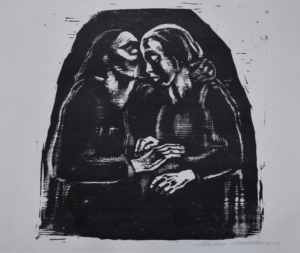
This week there are two scripture passages that have given my heart hope. One of them we heard this morning (which I’ll talk about shortly), and the other we would have heard if we’d been in church this past Monday. Nestled within our calendar, floating between the Easter season and Ordinary Time, is the Feast of the Visitation, always observed on May 31. This story in Luke’s Gospel tells of Mary, having just been told that she will bear the Son of God, realizing as the glow from the angel fades that she is in a precarious position; unmarried, pregnant, in a patriarchal society that takes a dim view of unmarried pregnant girls. So she immediately journeys to the hill country to see her kinswoman Elizabeth, also pregnant, after years of barrenness. The two women greet one another; one old, one young, both recipients of divine mystery. And Mary speaks.
“My soul magnifies the Lord,
and my spirit rejoices in God my Savior,
for he has looked with favor on the lowly state of his servant…
…He has shown strength with his arm;
he has scattered the proud in the imagination of their hearts.
He has brought down the powerful from their thrones
and lifted up the lowly;
he has filled the hungry with good things
and sent the rich away empty…”
These are prophetic words, from the mouth of a young, vulnerable, brown-skinned object of patriarchy and the Roman Empire, speaking of a world about to turn right-side up by being turned upside-down.
This young woman carries the future within her. She is the God-bearer, and she will not be silent.
Those with ears to hear, let them hear.
The child within Mary is born and grows to manhood. He stirs things up; he speaks of the Dream of God, he casts out demons. He calls a hated Roman-collaborating tax collector named Matthew to follow him. He eats with sinners and argues with church authorities.
And he draws the attention of a woman. A nameless woman who merits just two lines in Matthew’s Gospel, but whose story speaks volumes. Matthew tells us that she has been hemorrhaging for twelve years. We don’t know her age or the details of her ailment. But we do know that she’s been suffering for over a decade of her life, in first-century Palestine, with a condition that makes her socially and ritually unclean. She is an outcast in the community, worn down by illness and isolation.
Twelve years. Unseen. Unheard.
She sees Jesus. She knows his reputation as a healer; maybe she hears the synagogue leader plead with Jesus to come and raise his daughter. Perhaps, she thinks, this Jesus can help me too? She doesn’t have the power and influence of the synagogue leader. But for her, despair is not an option. She summons the courage to reach out her hand.
“…she said to herself, “If I only touch his cloak, I will be made well.”
Is it the light tug on his cloak? Is it the silent plea? Matthew leaves us to wonder. But three things happen next.
Jesus sees her.
He calls her “daughter.”
He heals her.
A tiny story, almost a footnote in the passage. But none of it should be underestimated.
Jesus saw a woman who was invisible to her community.
He called her family—daughter—when she had no one else to care.
He recognized the faith and courage within that brought her healing.
This is how the Dream of God unfolds. One small thing at a time.
We have today two stories of God-bearers; one, Mary, Theotokos, chosen from the edge of Empire to carry God into human life. And the other, a woman—named as daughter– who reached out in hope. She represents the God-bearer in all of us, carrying Divine dignity as beloved children of God.
These stories give me hope. I’ve carried them with me all week as I’ve talked to people trying to cope with the anti-ordinary, as they struggle to be seen, to be heard, not to be objectified, demeaned, and dismissed. To be valued.
The other evening I sat at dinner with friends who, like all of us, are worried about the state of the world and the casual cruelties we witness daily, whether in the media or in person. I was struck by the resolve of my companions, who confessed that in the past they had let casual prejudice and bigotry spoken in conversation pass in the name of keeping the peace. But now, they said, no more. “We must speak,” they said. Silence is not an option.
One small thing in a world of hurt. But small things, taken together, can turn the world around.
Our boot-camp assignment, then, in this season of Ordinary Time in anti-ordinary times, is to be the God-bearers that we were created to be, and to uphold the God-bearer who is our neighbor. Speak.
Speak truth to lies.
Speak love to hatred.
Speak freedom to oppression.
Speak inclusion to division.
Speak diversity to conformity.
Speak community to isolation.
Speak kinship to exclusion.
Speak joy into the silence of despair.
And may those with ears to hear, let them listen. Amen.
Prayers of the People, 2 Pentecost, 7 June 2026
The response to the bidding, “Lord, in your mercy,” is “hear our prayer.”
Loving God, bless your Church: Be our vision that we might follow where you lead, and guard us when we stumble that we might always persevere in continuing Jesus’ ministry of reconciliation and compassion.
Lord, in your mercy, hear our prayer.
We pray for the world in its brokenness, remembering those places where war, violence, injustice and disease are causing great suffering, especially in those places we name [pause]. We pray for the wisdom and will to bring peace, healing, and reconciliation to our wounded world.
Lord, in your mercy, hear our prayer.
God of Justice, embolden us to hold all of our leaders accountable to the values of interdependence, mercy, and unity in diversity; grant them wisdom and courage to work for the common good.
Lord, in your mercy, hear our prayer.
God abundance, we pray for your Creation, that we might be good stewards of your bounty, living in harmony with Mother Earth and reciprocating her generosity by protecting and preserving what She freely gives us.
Lord, in your mercy, hear our prayer.
Be present with those who suffer; bring healing and wholeness to those who are sick or injured, and lift up those who are weighted down by the darkness in the world. We remember especially Linda, David, Sam, Eileen, Sarah, Nate, and those we name [pause]
Let your wisdom and grace rest upon those who celebrate birthdays this week, especially Ian Tulungen, Missy Bennett, Raya Goff, Meg LoPresti, Jeana Whittredge, and Will Morgan.
We give thanks for the marriage of Arista Rose Ely, daughter of David Ely, to William Josh Barber here at St. Martin’s yesterday.
Lord, in your mercy, hear our prayer.
We pray for those we love but see no longer, especially Laurie Vieria, aunt of Len Walker, and those we name [pause]. We pray for all who grieve. Lord, in your mercy, hear our prayer.
Celebrant adds a concluding prayer.