
Worship Guide for March 15, 2026
Like TV Guide, but from God! Find the text of the Prayers of the People and Sermon below. Use the buttons provided to find other worship materials.
During Lent, we will use this worship booklet.
To see the Worship Guide for other weeks, click here.
To see the Book of Common Prayer online, click here.


From Sight to Insight
The Reverend Mark Sutherland
The Fourth Sunday of Lent
Sermon Audio:
Sermon Text:
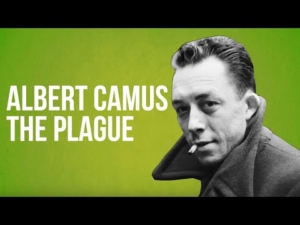
A few years ago, in a review in The New York Times, the philosopher Alain de Botton reflected on Albert Camus’ famous 1947 novel The Plague. Camus believed that plagues—what we now call pandemics—are not simply medical events. They are moments when a deeper truth about the human condition becomes impossible to ignore.
What plagues reveal, Camus suggested, is something that is always true: human beings are radically vulnerable. At any moment our lives can be interrupted—by illness, by accident, or by the actions of our fellow human beings.
Once we recognize that truth, another question quietly emerges. If life really is this fragile—if none of us is immune from suffering—then perhaps the most important question is not why suffering happens, but how we choose to live with one another in the midst of it.
In Camus’ novel, the citizens of the Algerian city of Oran struggle to accept this reality. Like many modern people, they assume that disasters of this magnitude belong to the past. Surely modern medicine and technological progress have changed the rules. Surely the plagues that devastated earlier centuries cannot happen to us.
Camus dismantles that illusion with unsettling clarity. In terms of the unpredictable fragility of human life, history marks no real progress. We remain just as vulnerable as our ancestors were.
As de Botton summarizes Camus’ insight:
“Being alive always was—and always will remain—an emergency.”
Those words land differently today than they might have only a few years ago. The daily terror of the COVID pandemic may now lie behind us, but its aftershocks remain. Our sense of stability has been shaken. The world that once felt predictable now feels far less secure.
We have been reminded—rather abruptly—that the structures on which we build our lives are more fragile than we like to admit.
And so many of us quietly find ourselves asking a simple question:
Where can we stand when the ground beneath us keeps shifting?
It turns out that this question is not unique to our time.
In John’s Gospel, Jesus and his disciples encounter a man who has been blind since birth. The disciples immediately ask a question that seems instinctively human:
“Rabbi, who sinned, this man or his parents, that he was born blind?”
It is a revealing question. The disciples are trying to impose moral order on suffering. They want a cause. They want someone to blame.
If misfortune can be explained—if it can be tied to sin or failure—then perhaps it can be contained. Perhaps it can be kept safely at a distance. If suffering happens because someone did something wrong, then perhaps the rest of us can reassure ourselves that we are safe.
It is a question as old as humanity—and as modern as today’s headlines.
Whenever tragedy strikes, we instinctively search for explanations that shield us from confronting a deeper truth: that we too are vulnerable.
But Jesus refuses the premise entirely.
“Neither this man nor his parents sinned,” he says.
In other words, you are asking the wrong question.
The man’s blindness is not a moral puzzle to be solved. It is simply part of the brokenness of the world we inhabit.
Throughout his ministry Jesus repeatedly challenges the human impulse to divide the world into categories of deserving and undeserving, pure and impure, sinner and righteous. Religion itself can become a tool for maintaining these distinctions—and when it does, it hardens the human heart.
Camus saw a similar pattern in The Plague. In the novel, a parish priest declares the epidemic to be God’s punishment for human sin. But the town’s doctor refuses that explanation. Rather than searching for meaning in suffering, he focuses on confronting it.
When asked how one fights a plague, he gives a simple answer:
“The only way to fight the plague is with decency.”
Pressed to explain what he means, he replies that “Decency means doing my job.” In other words: showing up for others. Caring for others. Refusing to let fear harden the heart.
The Gospel story moves toward a remarkably similar insight. When Jesus heals the man born blind, the miracle is not only physical. The man receives more than sight. His understanding deepens. At first he simply knows that someone named Jesus healed him. Then he begins to see Jesus as a prophet. Finally he recognizes that the one who healed him stands within the very life of God.
The miracle becomes a journey from blindness to sight to insight.
Meanwhile those who are most certain they already see—the religious authorities—remain spiritually blind. Confident in their explanations, they never move beyond judgment.
And that raises an uncomfortable question for us.
If our eyes were truly opened, what might we see?
Perhaps we would see that the fragile condition Camus described is simply the human condition itself. Perhaps we would see that suffering is not something that happens to “them” rather than “us.” Perhaps we would see that we are bound together by our shared vulnerability.
And if we could truly see that, something remarkable might happen.
Fear might loosen its grip. Our hearts might soften. And we might discover the same insight shared by both Jesus and Camus’ doctor.
In the face of uncertainty and suffering, our calling is not to explain the world, control it, or judge it. Our calling is simply to live with courage and decency.
Not the illusion that faith protects us from suffering. Not the fantasy that progress has eliminated our vulnerability. But a deeper hope rooted in solidarity and compassion.
Because in the end the truth the man born blind discovers is also the truth we are invited to see:
We are all in this together—equally fragile, equally dependent on grace.
And perhaps the most faithful response to that fragile condition is simply this:
to show up for one another,
and to do the work that lies before us—with human decency.
Click here for the Pastoral Letter
from the Presiding Bishop, The Most Rev. Sean Rowe, following the US and Israeli attack on Iran.
Prayers of the People
4 Lent
15 March 2026
The response to the bidding, “Lord,” is “Hear us, we pray”
On our Lenten pilgrimage, we accompany Jesus on the hard road to Jerusalem through the barren places in our lives, finding the courage to resist the forces of this world by proclaiming the gospel of our Savior in acts of service and costly witness. Lord: hear us, we pray.
We pray for our nation in a time of grave instability. Hear us, Lord, as we decry the perilous state of the Republic:
Where paramilitary forces are no longer subject to Constitutional restraint and legal accountability as they openly oppress law-abiding communities, and summary arrest, detention, and deportation are sanctioned on the basis of racial profiling;
and where the ugly face of corruption is practiced in plain sight, and sycophancy has replaced sound government, incompetence is masked by loyalty, and cruelty is celebrated through the abuse of Justice and Federal law enforcement:
May we have the courage to embrace non-violent resistance to the evils of this time. Lord: hear us, we pray.
We pray for the Church and her life: for Sarah, Archbishop of Canterbury; for Sean, Presiding Bishop, and for Nicholas, our bishop; for the brave witness of Hosam, Archbishop of Jerusalem. We give thanks for Pope Leo’s courageous and inspiring leadership, and we pray for him along with Bartholomew, Ecumenical Patriarch. We continue to pray for a witness and commitment to service and nonviolent resistance by all Christian leaders. Lord: hear us, we pray.
In a world of pressing needs:
We pray for an urgent de-escalation in the conflagration in the Middle East. We lament the folly of war as we pray for the safety of civilian populations and vital infrastructure exposed to the destruction of drone warfare.
We remember the plight of the Sudanese people, pawns in a wider Middle East power play.
We continue to pray for a negotiated peace in Ukraine that honors a commitment to Ukrainian sovereignty and future self-determination. Lord: hear us, we pray.
We remember the Earth and the threat of climate change, praying for the strengthening of emergency services and necessary infrastructure to meet the challenge of climate instability. Lord: hear us, we pray.
We pray for all in need and in trouble: for those whose strength is failing through ill health; whose spirits are flagging through depression; whose determination is being sapped through addiction; that they might know God’s comforting presence and healing. Lord: hear us, we pray.
We remember with love those who have asked for our solidarity in prayer: Bill, Brad, Sam, Carol, Arline, James, Connie, Beckie Ann, Ezra, Tina, and those we name.
We pray for our own needs, together with those nearest and dearest to us, remembering those celebrating birthdays this week: Helen Anthony, Carol DeBoer-Langworthy, Mark Sutherland, Tim Edgar, Deb DiPetrillo, Evelyn Tulungen, and Betsy Freeman.
Lord: hear us, we pray.
Rejoicing in the fellowship of so great a cloud of witnesses, we pray for those we love but see no longer, especially those we name [pause]. We pray for all who grieve. Lord: hear us, we pray.
Celebrant adds a concluding prayer.