
Worship Guide for March 22, 2026
Like TV Guide, but from God! Find the text of the Prayers of the People and Sermon below. Use the buttons provided to find other worship materials.
During Lent, we will use this worship booklet.
To see the Worship Guide for other weeks, click here.
To see the Book of Common Prayer online, click here.



The Moment of Inevitability
The Reverend Mark Sutherland
The Fifth Sunday of Lent
Sermon Audio:
Sermon Text:
John the Evangelist tells the best stories.
Yes, he has a habit of placing long, theologically dense speeches on Jesus’ lips—speeches that can test the patience of modern listeners. Yet even there, John gives us lines that land with force: servants are not greater than their master, or by this everyone will know that you are my disciples, if you love one another. Those still cut through the noise—perhaps especially for today’s political class.
But it’s really in his storytelling that John shines.
Everything he wants us to understand about Jesus unfolds through seven stories—what we call the signs of the kingdom. And these are among the most compelling narratives in the New Testament.
The raising of Lazarus is the seventh—and the turning point.
It is not just another story. It is the hinge on which everything swings toward what will unfold, just two weeks from now, over the course of a Thursday night and a Friday morning.
Let me offer a way into this story.
Roberto Assagioli, the founder of Psychosynthesis, once worked with Sigmund Freud before breaking away—like Jung—over Freud’s refusal to take the spiritual dimension of human life seriously.
Assagioli developed a way of listening he called bi-focal vision: the ability to attend simultaneously to two levels of experience—the personal and the transpersonal. The human, emotional story, and the deeper, spiritual one. Distinct, yet intertwined.
That turns out to be exactly what we need for John 11.
Because this is not just one story. It is two stories, woven together. A theological drama about the glory of God—and, at the very same time, a deeply human story of love, loss, and grief.
If we don’t learn to see both, we will misunderstand both.
So, the story so far.
Jesus receives word: his friend Lazarus is gravely ill. The message comes from Martha and Mary.
And Jesus… does nothing.
Or at least, nothing that makes sense to us. He says this illness will not lead to death but will reveal God’s glory—and then he delays. Two full days.
By the time he finally sets out, Lazarus is already dead and buried.
When Jesus announces that it’s time to go to Bethany, the disciples are alarmed. Judea is dangerous territory. Last time, he barely escaped with his life. But they go.
Martha, ever the doer, is watching the road. She runs to meet him. Mary, the contemplative one, remains inside—until Martha quietly tells her Jesus has come. Then she too goes out.
Both sisters say exactly the same thing:
Lord, if you had been here, my brother would not have died.
And from here, the story splits—two strands, two levels, unfolding side by side.
First, the encounter with Martha.
Here, Jesus speaks in the key of theology.
Martha’s words carry an edge—grief, yes, but also accusation. Why didn’t you come? And Jesus responds not with comfort, but with a question about belief. He presses her: Do you believe in the resurrection?
It’s not, frankly, his most pastoral moment.
But then he makes the claim that stands at the center of John’s Gospel: I am the resurrection and the life.
Martha rises to meet him there: Yes, Lord, I believe.
On this level—the transpersonal, theological level—Lazarus’ death is not tragedy but opportunity. The outcome is already oriented toward the revelation of God’s glory. From that vantage point, there is no anxiety, no urgency.
But then—John shifts the lens.
Now, the encounter with Mary.
Same words. Same grief. Same accusation.
But a completely different response.
Jesus does not argue. He does not teach. He does not examine her belief.
He is overcome.
John tells us he is deeply disturbed, shaken, moved to the core. And then, the shortest and perhaps most powerful line in all of Scripture:
Jesus wept.
Here, we are no longer in the theological register. We are in the human one. This is not about glory—it is about love. About loss. About the raw, unfiltered reality of grief.
And in this moment, Jesus is as vulnerable as anywhere in the Gospels.
He stands with Mary, not above her. And together, weeping, they go to the tomb.
And it is there—at the tomb—that the two strands come together.
The human and the divine. The tears and the glory.
Jesus weeps publicly for his friend. And then, just as publicly, he turns toward God: so that they may believe that you sent me.
What follows—Lazarus, come out!—is both.
It is an act of profound human compassion. And it is a revelation of divine power. It is love speaking—and glory breaking through.
And Lazarus comes out.
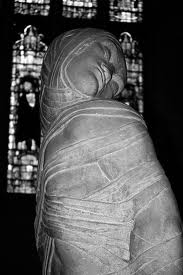
Still wrapped in the cloths of death.
If we stop the story there, it sounds like a happy ending.
But John won’t let us do that.
Because this is not a resolution. It is a trigger.
Yes, some who see this come to believe. But others do not. Instead, they go straight to the authorities.
And from that moment, the decision is made: Jesus must die.
The raising of Lazarus is not a detour around the cross. It is the event that sets the cross in motion.
And make no mistake—the cross is not just religious. It is political. The authorities justify their actions in the language of national security, of stability, of protecting the people.
Some things have not changed.
And one more thing.
What happens to Lazarus is not resurrection.
It is resuscitation.
He comes back—but only to the same life he had before. Which means, sooner or later, he will die again. This is a temporary reprieve, a limited-time restoration.
For John, the point is not Lazarus.
The point is trajectory.
What begins here—in resuscitation—will end somewhere else entirely: in resurrection.
But that is not a truth we can grasp from a distance.
It is one we can only understand by walking the road that lies ahead. By following Jesus into Jerusalem. Into conflict. Into suffering. Into death.
Only then will we know the difference.
So for now, we pray:
Almighty God, whose most dear Son went not up to joy before he suffered pain, and entered not into glory before he was crucified: Mercifully grant that we, walking in the way of the cross, may find it no other than the way of life and peace; through Jesus Christ our Lord. Amen.
Good Friday Offering with Presiding Bishop’s Message
Prayers of the People
Lent V
The response to the bidding, “Lord,” is “Lord: hear our cry.”
In Lent, we accompany Jesus, travelling through the barren places in our lives, finding the courage to resist the forces of this world by proclaiming the gospel of our Savior in acts of service and costly witness.
Lord: hear our cry.
We pray for the perilous state of the Republic. Lord, you know our concerns long before we ask. In this time of national crisis, we have so many concerns for our nation that it is impossible to mention them all. In silence or aloud, we bring before you our most pressing concerns: —-
[Pause]
May we have the courage to embrace non-violent resistance to face down the evils of this time.
Lord: hear our cry.
We pray for the Church and her life: for Sarah, Archbishop of Canterbury; for Sean, Presiding Bishop, and for Nicholas, our bishop; for the brave witness of Hosam, Archbishop of Jerusalem. We give thanks for Pope Leo’s courageous and inspiring leadership, and we pray for him along with Bartholomew, Ecumenical Patriarch. We continue to pray for a witness and commitment to service and nonviolent resistance by all Christian leaders.
Lord: hear our cry.
In a world of pressing needs too numerous to count, we are silent before you, imploring you to hear us as we stand in prayerful solidarity with people in places where lives and livelihoods are being destroyed by war, ethnic cleansing, and organized crime.
[Pause]
Lord, give us courage to hold fast to hope and work tirelessly for peace, not just any peace, but peace with justice. Lord: hear our cry.
We remember the Earth and the threat of climate change, praying for the strengthening of emergency services and necessary infrastructure to meet the challenge of climate instability.
Lord: hear our cry.
We pray for all in need and in trouble: for those whose strength is failing through ill health; whose spirits are flagging through depression; whose determination is being sapped through addiction; that they might know God’s comforting presence and healing.
Lord: hear our cry.
We remember with love those who have asked for our solidarity in prayer: Bill, Brad, Sam, Carol, Arline, James, Evelyn, David, and those we name.
We pray for our own needs, together with those nearest and dearest to us, remembering those celebrating birthdays this week: John Lawlor, Malakai Lacey, Luca Lombardo, Jennifer Potter, Anne Wood, John Marion, Susan Kostas, and Connie Hildesley.
We give thanks for the Blessing of Lifelong Relationship of Margaret Noel and Stefan Galazzi here at St. Martin’s yesterday.
Lord: hear our cry.
Rejoicing in the fellowship of so great a cloud of witnesses, we pray for those we love but see no longer, especially those we name. We pray for all who grieve.
Lord: hear our cry.
Celebrant adds a concluding prayer.