
Worship Guide for May 17, 2026
Like TV Guide, but from God! Find the text of the Prayers of the People and Sermon below. Use the buttons provided to find other worship materials.
During Eastertide we use this booklet.
To see the Worship Guide for other weeks, click here.
To see the Book of Common Prayer online, click here.




Completion
The Reverend Linda Mackie Griggs
Easter 7 Year A
17 May 2026
Sermon Audio:
Sermon Text:
“…as they were watching, he was lifted up, and a cloud took him out of their sight.”
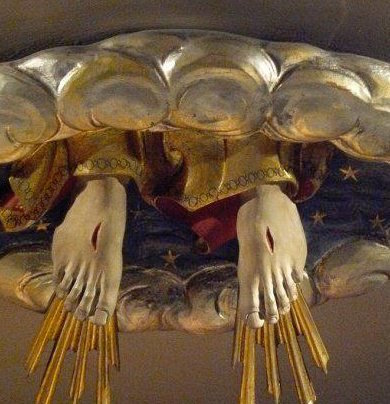
This past Thursday the Church observed the Feast of the Ascension, which takes place forty days after Easter and ten days before Pentecost. My mother used to sniff indignantly at the mention of Ascension, usually muttering something about the ridiculous image of the soles of Jesus’ feet rising into the sky as though on some kind of glass-bottomed elevator. Indeed, one of the most vivid portrayals of the Ascension has been mentioned here before; at the chapel at the Shrine of Our Lady of Walsingham in eastern England. Upon entering the chapel your eyes are drawn upward to two large bony plaster feet, with long nicely manicured toes, just… hanging there, with the metatarsals punctured by garish red nail wounds. You can see the hem of a gold robe draping around the ankles, and all of it nestled in a star-strewn dark blue background; the entire tableau encircled by gold plaster clouds. It is such an odd combination of sublime and ridiculous; you can’t help but know that the artist was sincere in their desire to portray something that is impossible to articulate—something awesome but defying sense (not to mention physics.) And yet, with all the sincerity of the effort, you just want to shake your head and say, with full Southern nuance, “Bless their heart.”
So on the one hand we have a devout feast of the Church, and on the other a concurrent struggle to grasp it—how it all works—whether it was real—how to respond to a story and image so awkward in our rational world. But. Consider the tenets of the Christian faith that we acknowledge every time we say the Creeds, for the most part never blinking an eye: the Incarnation—God becoming human; Virgin birth; resurrection. Add to these the miracle healings; loaves and fishes, walking on water. These are simply part of what we open our hearts, minds, and imaginations to as Christians. We accept so much to be true–even if not factual–about our faith, not to mention Jesus’ teachings themselves: loving our enemies, turning the other cheek, God’s preference for the poor and the downtrodden. All of these are awkward in today’s world, yet we open our hearts to them—or at least we want to. But Ascension? Jesus and the Great Glass Elevator? Now that’s a bridge too far.
Luke is alone of the four Evangelists to relate the story of the Ascension. He is also alone of the Evangelists to write a sequel to his Gospel—part one, which is the story of Jesus—and the Acts of the Apostles, part two, which tells the story of the early Church. So there is a practical reason for this episode in the narrative. And let’s face it, our rational, analytic, disenchanted present-day minds will glom happily onto a practical reason.
Luke was writing in an era of a three-tiered universe—a cosmology that divided the universe vertically into Heaven, Earth, and Underworld. It wasn’t until much later that this vertical orientation began to give way to more expansive models, such as that of St. Bonaventure, who said that God’s “center is everywhere and whose circumference is nowhere.” So Luke’s literary problem was, how to get Jesus from the human realm of the Gospel, “down here,” to the divine realm of Acts, “up there”? Luke did have the advantage of Old Testament tradition to work from, with the story in Second Kings of the prophet Elijah being taken up into the sky in a whirlwind with a chariot of fire. So, actually, the concept of Jesus ascending into the clouds was something Luke’s audience would find far easier to visualize and accept than we would.
So there we have it: Jesus makes the literary move from the original to the sequel, setting the stage for Pentecost, the coming of the Holy Spirit, and the birth of the Church:
“…you will be my witnesses in Jerusalem, in all Judea and Samaria, and to the ends of the earth.”
Mystery solved. Our rational, intellectual, inquisitive, analytical, disenchanted minds are satisfied; the Ascension as literary device.
But you know what? Luke may have had the gifts of a masterful storyteller. But that’s only the vehicle by which he communicated what was most important; a compelling spiritual and theological narrative that helped to change the world. We cannot, and should not, ignore the fact that the Ascension, awkward though it may be, is deeply theological and foundational for our faith.
The Ascension of Jesus is the completion of the Incarnation.
Incarnation—God with us. The Divine comes to Earth to share our lives, our joys and our suffering, even our death. I remember two colleagues speculating as to which was more difficult for God, Resurrection or Incarnation. They concluded it was the latter, because what must it take for an all-encompassing God to squeeze into puny flawed little us? Yet that is what God did in Jesus—bringing the divine to Earth to live and die as one of us and to reveal the unfolding of the Dream of God for Creation.
In the Ascension the resurrected Jesus returned to the God who loved him into being—he returned with his wounds–the marks of his suffering and death–thus completing what God began in coming to Earth as a human child. In the Incarnation Divinity came to Earth, and in the Ascension, humanity was enfolded back into God.
Brother Luke Ditewig of the Society of St. John the Evangelist puts it this way:
“Returning to heaven didn’t diminish Jesus’ humanity. Jesus ascended with wounded hands and feet, needing food and companionship, vulnerable to and for love and heartbreak, grief and trust. Mysteriously wonderful. Loving us humans, God comes all the way down to restore all, and God takes all up. The good news is that all will be healed, all will be fully loved.”
This is not just a literary device. It’s good theology for any open, yearning heart.
“While he was going and they were gazing up toward heaven, suddenly two men in white robes stood by them. They said, “Men of Galilee, why do you stand looking up toward heaven?”
Jesus had already given the disciples their marching orders: Wait for the coming of the Holy Spirit, and then witness; spread the Good News throughout the world. This was no time for extended pondering. It was time for the disciples to lower their gaze from the heavens; to look to one another, and to their neighbor.
Wait. And then Witness.
The Church was about to be born. After Pentecost the Way of Jesus would spread like wildfire, magnetic communities sprouting and growing by leaps and bounds, with more being added to their number every day. It was an exciting time; not without peril or challenges, but Spirit-fueled and joyful. Jesus had returned to God and was newly incarnated as Beloved Community—the Body of Christ.
And we are part of that.
It’s an exciting time. Today the Household of God will welcome, not one, not two, but five beloved children of God, and if that’s not the work of the Spirit, I’m not sure what is. As this community opens our arms and hearts to these little ones, and prays for Josie, Marcello, Camilla, Tessa, and Casey, we are welcoming them, not just into St. Martin’s Church, but into God’s church, which extends far beyond these walls. As we witness these baptisms we represent the whole Body of Christ, who is called to equip these children to live out our Covenant to work for justice, freedom and peace, to seek and serve Christ in all persons, and to respect the dignity of every living creature.
“…why do you stand looking up toward heaven?”
There is much to do right here. Five beloved children of God are being added to our number this morning; what a great day for the Church!
Baptism Prayers
Celebrant Let us now pray for Tessa, Josie, Marcello, Camilla, and Casey, who are about to receive the Sacrament of new birth:
Leader Deliver them O Lord, from the way of sin and death.
People Lord, hear our prayer.
Leader Open their hearts to your grace and truth.
People Lord, hear our prayer.
Leader Fill them with your holy and life-giving Spirit.
People Lord, hear our prayer.
Leader Keep them in the faith and communion of your holy Church.
People Lord, hear our prayer.
Leader Teach them to love others in the power of the Spirit.
People Lord, hear our prayer.
Leader Send them into the world in witness to your love.
People Lord, hear our prayer.
Leader Bring them to the fullness of your peace and glory.
People Lord, hear our prayer.
Celebrant Grant, O Lord, that all who are baptized into the death of Jesus Christ your Son may live in the power of his resurrection and look for him to come again in glory; who lives and reigns now and forever. Amen.
(Book of Common Prayer pp. 305-306)