
Worship Guide for May 31, 2026
Like TV Guide, but from God! Find the text of the Prayers of the People and Sermon below. Use the buttons provided to find other worship materials.
To see the Worship Guide for other weeks, click here.
To see the Book of Common Prayer online, click here.


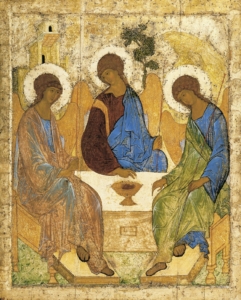
Incomprehensible
The Reverend Linda Mackie Griggs
Trinity Sunday
31 May 2026
Sermon Audio:
Sermon Text:
“Incomprehensible”
“Go therefore and make disciples of all nations, baptizing them in the name of the Father and of the Son and of the Holy Spirit”
In the first semester of the first year of seminary, they throw you in the curricular deep end. The course is a survey of the history and writings of the Early Church Fathers (yes, sigh, Fathers), or as we called it, Patristics.
So many writers. So many theological proposals. So many church councils. So much heresy (Arian, Sabellian, Gnostic, Docetist) and so little orthodoxy (What is orthodoxy? That was the question.) So much vocabulary; to this day I still need to refresh my memory on modalism (don’t ask.) So much passion, and so many fistfights (including, it was rumored, St. Nicholas!) I wish I could say that I retained it all beyond the final exam and papers, but alas. And yet, not long after graduation (yes, it took two and a half years), something clicked.
It’s the Trinity, stupid.
All that ink (and blood) spilled, and it came down to those four words.
Three distinct Persons. One Substance. Co-eternal and uncreated. Not three, but One. Yet three in One.
According to the creed attributed to St. Athanasius (pp. 864 and 865 of the Book of Common Prayer):
“The Father incomprehensible, the Son incomprehensible, and the Holy Ghost incomprehensible…As also there are not three incomprehensibles, nor three uncreated, but one uncreated, and one incomprehensible.”
Does it make sense? No?
Good.
It’s not supposed to.
The whole point of the decades-long struggle for orthodoxy, or “right thinking,” on the Trinity wasn’t to understand it. It was to protect the wonderful paradoxical mystery of it, to protect the fact that we can’t understand it If we think we’ve got it, then we most assuredly don’t. The identification and persecution of so-called heretics and the censoring/burning of their works was intended to silence those who insisted on explaining the Trinity in a way that people could understand. Proponents of orthodoxy, including Athanasius, Gregory of Nazianzus, Gregory of Nyssa and Basil the Great, sought to protect the mystery–the very incomprehensibility–of the Trinity, so that in not comprehending, we would release the temptation to hold on to a God that is beyond grasping; release the temptation to create God in our own image (a temptation that persists even today.)
This is not to say that persecuting and censoring were a good thing. It is never a good thing. So there remains a tension that will not be resolved here, nor can it be ignored: Did the Patristic passion to articulate that which could not be articulated in any way excuse the silencing of those who offered different explanations of the Divine? Were the Church Fathers, who, as of the year 312 were safely under the imprimatur of the Roman Empire, simply exerting imperial conformity on the young church in order to control it?
Or did the Spirit find a way to work with what She had?
There’s the tension.
That said…so what?
In the throes of all that wondering and studying and note-taking and memorizing all those mountains of Patristic arguments, both heretical and non-, that was my question, too.
So what?
How does all of this feed people? How does it heal? How does it bring justice and peace? How does it accompany the lonely and comfort the grieving?
What is it about this Trinity Sunday that can change lives for the better in a world that hurts in so many ways?
Three words:
It’s Relationship, stupid.
In the beginning when God created the heavens and the earth, the earth was a formless void … Then God said, “Let there be light”; and there was light…and God separated the light from the darkness. God called the light Day, and the darkness he called Night.
In a pair of lovely essays in The Christian Century, Lutheran pastor Brian Maas uses today’s Old Testament and Gospel passages as a springboard to his reflection on the Trinity. In the Creation story he observes that God brought order out of chaos by separating things one from another; light and darkness, sky and land, land and sea. So out of chaos God exercised generativity (creation), separation, and naming, a pattern that repeats throughout the narrative. Focusing in on the act of separation, Maas warns against the dangerous thinking that separation was an end in itself, since separation as a prime motivator for human society has brought us to a precipice of untold grief. Rather, the point of separation/setting apart had everything to do with engendering relationship:
“Yet the pattern of creation, like the identity of God’s very self, isn’t about separation for its own sake. It’s about giving things identity so that they can be in relationship. Day isn’t just separate from night; it’s in a rhythmic relationship with night. Dry land isn’t just divided from water; it exists in relationship with water, and both exist to provide symbiosis with plants and with animals, all of which contain within them the generativity first practiced by God.
Creation reaches its pinnacle in humankind, created in God’s image, formed in God’s likeness, established not one at a time but in a pair, so that they may relate to one another.”
Relationship, identity, generativity—all are characteristics of God, not to be mapped onto the Trinitarian pattern of Father/Son/Spirit or Creator/Redeemer/Sustainer, or even Lover/Beloved/Love Sharer. That’s too clean, too comprehensible. But to engage with God as the One (in Three) who creates, names, and relates is to begin to understand the real-world implications of Trinitarian theology.
We are in a dangerous moment. Corrupt politics, rampant capitalism, and unchecked technology threaten to sink us into chaos—a formless void of alienation, violence, and climate disaster. This moment yearns for us to see what has been true since the beginning of time; that the way out of chaos is through the cultivation and nurturing of mutual lifegiving relationship; with one another, with Creation, and with God, whose very identity shows us the way.
Trinity as Relationship: An ever-renewing dance of generosity and reciprocity–always giving, always receiving–between three separate yet co-eternal and co-equal Persons, however we choose to name them. It is this–perhaps mind-blowing, perhaps comforting, perhaps both– Divine image that is the foundation for our human identity. Or, as Brian Maas calls it, “the with-ness undergirding [our] witness” to the Good News of the Dream of God.
“Go therefore and make disciples of all nations, baptizing them in the name of the Father and of the Son and of the Holy Spirit”
The Trinity isn’t an intellectual exercise. It’s the template for our life together as children of God, citizens of Mother Earth, and disciples of the Way of Love. Generosity, not accumulation. Reciprocity, not withholding. Interdependence, not alienation. Welcome, not othering. Relationship, relationship, relationship.
Maas writes:
“Isn’t this the gift and the genius of the Holy Trinity, from the Holy Trinity, and about the Holy Trinity? That…we are encouraged to fulfill our own baptismal call as agents of the fullness of God Almighty, even when we can’t grasp the whole of what such an identity means? That we might lean in any given moment on the promise that the Spirit’s power will become our own to sustain us, on the awareness that we and the whole of creation are good because we are the work of the Father who created us or on the certainty of our value to God because of the…grace of the Son who redeemed us?”
I ask that we hold this in our hearts in a moment, as we speak the words of the Nicene Creed, which is a summation of the Patristics’ best articulation of the incomprehensible Godhead. It begins, “We believe”, which is from the Latin meaning to open our hearts. While it may be true that the Early Church sought conformity and uniformity through this Creed, the both/and of the matter is that at its core it asks us to question, to be curious, to engage with its description of the Trinity, to open our hearts to the mystery of the fullness of God, not for the purpose of moving in lockstep, but in order to join in the dance of mutual lifegiving relationship for the sake of the world’s healing.
Prayers of the People, Trinity Sunday, 31 May 2026
The response to the bidding, “Holy Trinity, One God,” is “hear our prayer.”
Wondrous God, we pray for your whole Church, that we might strive to be one, as you are One, that we might fulfill your call to ceaselessly give witness to the power of Christ’s example and persevere in continuing his ministry of reconciliation and healing. Holy Trinity, One God, hear our prayer.
Embolden us to hold all of our leaders accountable to the values of interdependence and unity in diversity; grant them wisdom and courage to work for the common good. Holy Trinity, One God, hear our prayer.
We pray for the Creation, that we might be good stewards of God’s bounty, living in harmony with Mother Earth and reciprocating her generosity by protecting and preserving her abundant gifts.
Holy Trinity, One God, hear our prayer.
We pray for the world in its brokenness, remembering those places where war, violence, and injustice are causing great suffering, especially in those places we name [pause]. We pray for the wisdom and will to bring peace and reconciliation to our wounded world. Holy Trinity, One God, hear our prayer.
Bring healing to what is broken in our lives and in the lives of those important to us; remembering especially Linda, David, Sam, and those we name [pause]; that they may find release from their anguish and wholeness in their souls. Holy Trinity, One God, hear our prayer.
Let your wisdom and grace rest upon those who celebrate birthdays this week, especially Joshua Lacey, Jane Taylor, Jackie Phillips, Bob Wood, Mark Aaron Perry, Chris Izzo, Peter Lofgren, John Staniunas, and Dana Welshman.
We give thanks for the birth on May 28 of Rowan Quinn Zabinski, son of Ben Zabinski and Brooke Huminski.
We give thanks for the marriage of Elizabeth Suzanna Barr, daughter of Kathryn and Tom Barr, to Matthew Thomas Vezey on May 23 in Nashville, Tennessee. Holy Trinity, One God, hear our prayer.
We pray for those we love but see no longer, especially those we name [pause]. We pray for all who grieve. Holy Trinity, One God, hear our prayer.
Celebrant adds a concluding prayer.