
Worship Guide for November 15, 2026
Like TV Guide, but from God! Find the text of the Prayers of the People and Sermon below. Use the buttons provided to find other worship materials.
To see the Worship Guide for other weeks, click here.
To see the Book of Common Prayer online, click here.


What Is Ours To Do?
The Reverend Linda Mackie Griggs
Twenty-Fifth Sunday after Pentecost
Judges 4:1-7
Psalm 123
1 Thessalonians 5:1-11
Matthew 25:14-30
Sermon Recording
Sermon for November 15, 2026
“It is as if a man, going on a journey, summoned his slaves and entrusted his property to them; to one he gave five talents, to another two, to another one, to each according to his ability. Then he went away.”
The Parable of the Talents. I had a colleague who hated preaching about parables. This story might have been the reason. There are myriad ways of interpreting the characters, their words, their actions, and the hellfire ending, but nothing really satisfactory, unless, that is, you want to interpret the story as a resounding affirmation of unfettered capitalism and the prosperity Gospel—God wants you to make lots of money!
Nope. Not in this pulpit.
The only way to come at this parable is to step back and look at its greater literary, biblical, and historical context.
So the best way to begin, is with– The End.
In Matthew’s telling of the Parable of the Talents, Jesus is in Jerusalem during the last week of his life. He is teaching his disciples about the Last Judgment, the Second Coming of Christ–these refer to different aspects of the same concept, which is what happens when Christ returns at the end of time. We refer to it at least twice each Sunday; in the Nicene Creed: “He will come again in glory to judge the living and the dead”, and again at the Eucharist: “We remember his death, We proclaim his resurrection, We await his coming in glory.”
This is an astounding claim—there is a reason we refer to it as “the mystery of faith.” How do we wrap our heads around it? Frankly, in our heart of hearts, do we even want to? We have a hard enough time dealing with our own death, much less the idea of the end of the world as we know it and an accounting before God of how we have lived our lives.
And yet, a life of faith necessitates an understanding that there is more to Creation than what we know. Scripture and tradition are what we have to help us to reason* what is ours to do as Christians in this time between Christ’s Ascension and Christ’s return.
So, Matthew’s take on Jesus’ teaching about the return of the Son of Man is rooted in the community’s experience of Roman occupation, war, and the trauma of the destruction of the Temple in the year 70. So we can hear in Matthew’s narrative a distinct apocalyptic tone. Apocalyptic themes emerge when people who have been oppressed envision an ultimate victory, accomplished through divine intervention, in which the evil ones receive just recompense for the misery and destruction that they have wrought upon their victims.
“…throw him into the outer darkness, where there will be weeping and gnashing of teeth.’”
Matthew’s community in the aftermath of the Temple destruction was angry and exhausted and desperately in need of a happy ending–just not for their oppressors. So Matthew here isn’t necessarily making a theological claim as much as an emotional one. Context is important.
Jesus’ final discourse actually includes three parables, which cannot be fully understood unless they are in conversation with one another and with the question raised by Jesus’ overall discourse: How are we to live in the between-time after Ascension and before the final realization of the Dream of God that is even now unfolding? By the time Matthew’s Gospel was written the followers of the Way of Jesus were wondering how long they were to wait for what they had thought would be an immediate event. Last week’s Gospel passage was the Parable of the Foolish Bridesmaids who didn’t have enough oil for their lamps for the bridal procession, and who were shut out of the banquet and left out in the dark.
The focus is often on Jesus’ words at the end, “Keep awake therefore, for you know neither the day nor the hour.” But while five bridesmaids were without oil, all ten had fallen asleep while awaiting the bridegroom. So maybe the point isn’t so much an anxious concern about the when of the Bridegroom’s (read Jesus’) arrival, because it says right there that we do not know. Rather consider how to be equipped in the present regardless of the timing of the future. Theologian Andrew McGowan suggests that we consider the oil—what does it symbolize? Matthew’s Gospel is primarily about faithful practice—loving service to others. Therefore showing love—the oil for our lamp— is the primary evidence of the Dream of God unfolding.
So now, thanks to this conversation between passages, we begin to have an overall context that begins to shed light on what Jesus is inviting and challenging us to in this between time.
The Parable of the Talents is, as I’ve said, one of the most frustrating to explore– what The Christian Century masterfully understates as “tricky.”
We have a landowner (Is he God? Jesus? An absentee landlord who is part of the corrupt system of the time?), three slaves, and three Musk-worthy piles of money that virtually no one in Matthew’s or Jesus’ audience would take seriously. What might be of tremendous, prodigious value that is not simply money? We’ll just leave that there for a minute.
The talents are parceled out to the slaves according to their ability, and even the least amount is worth about fifteen years of an annual wage. The landowner leaves, for “a long time,” and the slaves get busy. Two of them double their money—the story doesn’t say how, so it apparently doesn’t matter, and the approbation from the landowner when he returns is the same for each, “Enter into the joy of your master.”
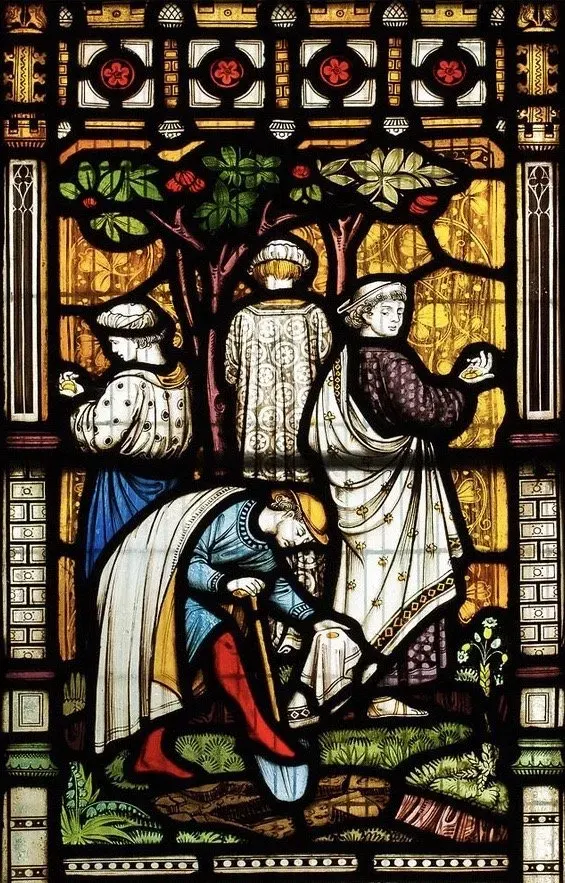
It is the third slave who is drawn more vividly as a character. We see him furtively bury his share in the ground; something, by the way, that would not have been thought by Matthew’s audience to be such a terrible thing—sort of like hiding money under the mattress during the Depression. Nevertheless, he is resentful of the landowner, calling him harsh and corrupt when actually the landowner had been generous and trusting of each of the three slaves. And the landowner is furious—in spite of receiving his money back, although without interest—he calls the slave wicked, lazy, and worthless–and, predictably by now, outer darkness, weeping and teeth-gnashing ensues.
What has provoked the landowner’s harsh reaction?
Look again at context; the overall question is how to live a faithful life in this between-time of awaiting the return of Christ. One response, from the parable of the bridesmaids, is to live in readiness by participating in the unfolding Dream of God through carrying the light of love for our neighbor. How does the Parable of the Talents fit in? With what were the slaves entrusted, and what was the faith and practice that the third slave neglected to his peril? Looking closely at his speech to the landowner, we see three words.
“I was afraid.”
“I was afraid, and I went and hid your talent in the ground. Here you have what is yours.”
How do we live a faithful, loving life in the between time as the Dream of God continues to unfold?
We do it without fear. We take the risk of loving our neighbor, courageously proclaiming the Gospel and shining our light in a dark time. To do otherwise is to waste the unimaginably precious gift from God that is our own hearts broken open to compassion, and the acts of justice and mercy that flow from it. To do otherwise is to bury our very selves, and with it the Good News entrusted to us. And that grieves the heart of the One who yearns for us to enter into God’s joy.
There is a third parable in Jesus’ last discourse, and it is a doozy. But I’m saving it for next week, so I guess you could call this a cliffhanger sermon. Which is quite appropriate when you think about it. So, we await the final chapter. In the meantime, what is ours to do?
*With thanks to Richard Hooker, author of the “three-legged stool” of Anglican theology: https://southernanglican.substack.com/p/the-three-legged-stool-of-anglicanism
Prayers of the People