
Worship Guide for November 22, 2026
Like TV Guide, but from God! Find the text of the Prayers of the People and Sermon below. Use the buttons provided to find other worship materials.
To see the Worship Guide for other weeks, click here.
To see the Book of Common Prayer online, click here.


What Is Ours To Do? pt. 2
The Reverend Linda Mackie Griggs
Twenty-Fifth Sunday after Pentecost
Ezekiel 34:11-16, 20-24
Psalm 100
Ephesians 1:15-23
Matthew 25:31-46
Sermon Recording
Sermon for November 22, 2026
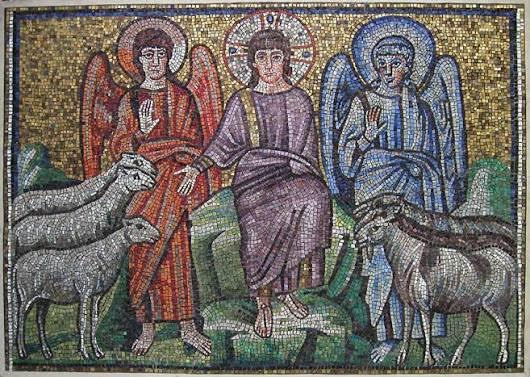
“When the Son of Man comes in his glory, and all the angels with him, then he will sit on the throne of his glory. All the nations will be gathered before him, and he will separate people one from another as a shepherd separates the sheep from the goats…
The sheep from the goats.
As promised, here is the conclusion of last week’s cliffhanger sermon, but first…
For those of you who didn’t tune in last week, as they might say on television:
“Previously on Jesus’ final discourse in Matthew’s Gospel…”
…the followers of Jesus were taught, through the Parables of the Foolish Bridesmaids and of The Talents, the importance of faithful practice during the time between Christ’s Ascension and his Second Coming; of the need to live faithfully in the present moment by shining the light of love through acts of mercy and justice, and of doing so without fear, courageously proclaiming the Good News in word and action.
“…And now, the conclusion of “What is Ours to Do?”
As I hinted last week, Jesus was saving the best of his parables for last, and it packs a punch:
“…he will put the sheep at his right hand and the goats at the left…”
Even before we get to the crux of this passage, we have the proverbial elephant in the room: The sheep are the righteous, while the goats are eternally cursed.
For Matthew’s community, having faced war and trauma at the hands of Empire, this was a satisfying ending. But as I noted last week this is more of an emotional response than a theological one. It is perfectly normal to desire retribution when one has suffered wrong, and Matthew’s apocalyptic imagery brings it in spades—divine deliverance of eternal fire and punishment.
Does this sound like God to you?
It sounds more to me like someone in a lot of pain. We know these people. Sometimes we are these people. And I dare say if we were charged with writing a gospel while having a really a bad day, we might be tempted to portray God more in our image than in God’s own.
The fact is that this depiction of the Last Judgment is the only one of its kind in the Gospels. (The Revelation to John, written later than the Gospel of John, is a whole ‘nother story and a sermon series all by itself.) The other Gospels don’t include comparable passages, and if we go by the interpretive rule that if a story is included in two or more gospels it is therefore Very Important, then the fact that only Matthew offers this depiction of the Second Coming leaves the door wide open to conversations with other passages, such as the one for example in Matthew’s own Gospel, “So it is not the will of your Father in heaven that one of these little ones should be lost.” Or in Luke and in John: “Then Jesus said, “Father, forgive them, for they do not know what they are doing.”
Does this sound like God to you? The God whose Dream is centered upon the kingship of the One who gave himself as a free and costly gift for the forgiveness of all of the world’s sin, past, present and future? A restorative God who has yearned from the beginning for relationship and reconciliation of all, not just some, of Creation?
This does not mean that God is not serious about sin, or that Matthew’s sense of urgency is misplaced. It just means that Matthew’s eschatology is incomplete. We simply can’t know what the Last Judgment will be like. But we can trust in the God we know; one who has called us into relationship with God, Creation, and one another since the very beginning, who challenges us every day to work for the healing and restoration of the world, and who has promised that God’s Kingdom will be done, “on earth as it is in heaven.” That’s what we know, and all we need to know.
Well, almost. What does it look like to work for the healing and restoration of the world? Jesus is crystal clear, in language that has endured for two thousand years as the gold standard of faithful practice:
“…for I was hungry and you gave me food…I was in prison and you visited me.’”
The righteous and the unrighteous alike are mystified by this— “When was it that we saw you hungry or in prison?” “Surely if we had seen you, we would have done something to relieve your suffering, Lord?”
Jesus’ response is perhaps the clearest possible instruction of what it means to follow him; second only to his command (command!) to love one another:
“’…just as you did it to one of the least of these… you did it to me.’”
We need to be careful with the unfortunate translation, “the least of these” because there is a risk of seeing people in need as actually being “less-than.” This just feeds into an us-them mindset that denies what our Baptismal Covenant calls respect for “the dignity of every human being.” So even though people roll their eyes when I say it because I have said it so often; when you see the phrase “the least of these”, replace it with “the most vulnerable of these”, because that is what Jesus meant.
This passage has become so emblematic of faithful practice that there is a movement called “Matthew 25 Christianity” that sets itself over and against the heresy of White Christian Nationalism. Whereas the latter focuses on a view of this country as an exclusively Christian nation that prioritizes those of White European origins (which is in itself an un-Christian concept), Matthew 25 Christianity teaches that society’s chief responsibility is compassion toward all of our neighbors, no matter who they are or where they are from.
This isn’t just a matter of individual acts of charity and service, although these are important. Note that in Jesus’ parable the King will sit on his throne, and the nations will be gathered before him. So this is also a matter of calling systems and institutions to account for how they treat the most vulnerable, not just those who have the most money and privilege.
Consider some recent statistics: According to the Rhode Island Community Food Bank, 38% of Rhode Island households are food insecure; 33% of White households, 47% of Black households, 55% of Latino households. Low income Rhode Islanders miss over 42 million meals each year—and that was counted in 2024 before SNAP benefits started being curtailed by the federal government.
In other news, on Thursday the AI company Anthropic had the largest initial public offering in history, valuing the company at an eye-popping 2 trillion dollars. The seven founders reaped a windfall of over twenty billion dollars apiece.
While one third of Rhode Islanders wondered where the next meal would come from
Sit for a minute with that.
It was Desmond Tutu who said,
“There comes a point where we need to stop just pulling people out of the river. We need to go upstream and find out why they’re falling in.”
This is the invitation and challenge of Matthew 25. Jesus speaks of judgment in an eternal sense, but the eternal begins in the present, and the consequences of not being mindful of our interdependence with one another and Creation are unfolding before us– darkness and fire and flood and famine and plague that we don’t have to wait until Judgment Day to see, and it is sweeping the most vulnerable of God’s children up in its path.
When Matthew wrote his Gospel he wasn’t writing from a place of privilege. He and his audience were “the least of these,” urgently demanding transformation of hearts and systems while there was still time. I’d even wager that they knew what we all must admit– that sheep and goats— the capacity for both compassion and indifference–coexist within us all. And this is where the urgency of Matthew 25 is woven tightly with hope; with the fact that we have a choice: Which will we nurture—indifference or compassion? And which will flourish in this between-time as we await the consummation of the Dream of God?
Prayers of the People