
Worship Guide for November 23, 2025
Like TV Guide, but from God! Find the text of the Prayers of the People and Sermon below. Use the buttons provided to find other worship materials.
To see the Worship Guide for other weeks, click here.
To see the Book of Common Prayer online, click here.




A King, but what kind of a King?
The Reverend Mark R. Sutherland
The Last Sunday after Pentecost: The Kingdom of Christ
Proper 29
Jeremiah 23:1-6
Canticle 16
Colossians 1:11-20
Luke 23:33-43
Audio: Note the recording is a version of the text below streamlined for oral delivery
Sermon
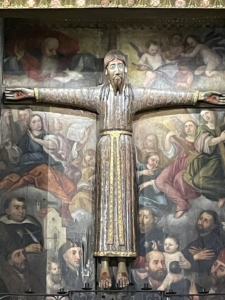
Image: 9th-century Christ figure, Esglesia de Sant Cristofol de Beget, Catalonia.
This Sunday, the last in the season after Pentecost, brings us again to the Feast of Christ the King. It’s worth remembering that this is a relative newcomer to our Anglican–Episcopal calendar. Traditionally, the Sunday before Advent was known as Stir-Up Sunday—from that marvelous opening of the old Collect for Advent Sunday. We now find his Collect moved to Advent II.
“Stir up, we beseech thee, O Lord, the wills of thy faithful people…”
In England, of course, this also served as the annual cue for the vigorous stirring of the Christmas pudding. A lighthearted association, yes—but there is a deeper, more unsettling story beneath the surface of this day.
100 years ago in 1925, Pope Pius XI instituted the Feast of Christ the King as an explicit protest against the rise of fascism and the growing threat of communism. His instinct was to reassert the old Constantinian notion of the Church as the supreme earthly authority—the singular center of allegiance for Roman Catholics. At tremendous cost to freedom of thought and conscience within the Church, he marshaled his legions against those he perceived as rival authoritarian powers.
It is, as you’ve heard me say before, an old and familiar story: one form of authoritarian power confronting another. And for us, for our Anglican sensibilities and ecclesiology, this is problematic. We do not imagine ourselves as an authoritarian church, nor do we look to the state to wield sacred authority on our behalf. And so we are forced to ask:
What kind of king, and what kind of kingship, are we actually celebrating today?
The first chapter of Genesis tells us that humanity—male and female—is made in the image and likeness of God. But if God is unseen, then the only way we can learn anything about God is by taking a long, honest look at ourselves.
And this is where things immediately become complicated.
For which image of humanity is God reflected in?
The compassionate one?
The jealous one?
The collaborative one?
The violent one?
Perhaps, in some mysterious sense, all of them?
This double-edged mirroring cuts both ways. We deduce that God is loving, relational, and faithful because we find traces of these aspects within ourselves. But we also project onto God our fear, our rage, our desire for power and control—because these too are embedded so deeply within us.
This is why the Bible’s shifting, sometimes contradictory portraits of God may have more to do with the conflicting, constantly changing images of ourselves than with any actual change in God. And so today’s great question arises again:
Which of our many competing self-images do we want Christ the King to reflect?
The Church has never lacked for imagery.
Pantocrator—the omnipotent ruler of the universe—gazes down from Orthodox domes and even from our own great West Window at St. Martin’s, itself a war memorial. In this rendering, Christ is robed with imperial grandeur, presiding over the world with absolute command.
Christus Rex, the risen high priest, appears in the reredos of the St. Martin Chapel—Christ triumphant, the cross firmly behind him now, is decked in priestly attire; new life springing forth from resurrection’s victory.
But then there is that other image—stubborn, uncomfortable, and impossible to romanticize:
the one who reigns not from a throne but from a cross.
Not robed in splendor but stripped of all earthly power.
Not lifted above humanity but nailed into its deepest suffering.
This third image refuses the familiar pairing of strength over against vulnerability. It insists instead on a revolutionary pairing:
strength through vulnerability,
continuity reshaped by disruption,
life emerging from death.
This is the image Luke gives us today in Jesus’ Passion. Here, Christ’s kingship shines through the very moment when Rome, the Temple, and a frightened populace converge to crush him. He refuses to play the power game. He refuses to mount a defense that mirrors their tactics. His vulnerability becomes the very thing that reveals divine strength.
We are living, once again, in an interesting moment—interesting in that biblical sense where the tectonic plates shift beneath our feet. Authoritarian voices rise across the world; fear becomes a political currency; purity narratives—racial, religious, cultural—gain traction among anxious populations. Meanwhile, many feel that continuity is slipping away, that the old certainties no longer hold.
Newton’s Third Law quietly reminds us: for every action there is an equal and opposite reaction. And so the pendulum of history swings between order and chaos, continuity and disruption, stability and fracture.
Like Pope Pius XI a century ago, we, too, are tempted to imagine that the only adequate response to coercive power is counter-coercive power. Strength for strength. Force for force. A sort of theological arms race.
The danger here is subtle but real:
when God is remade in our image, it is only a matter of time before violence, domination, and exclusion become divinely sanctioned.
And so Christ the King asks us to choose carefully which image of ourselves we are willing to project onto God.
Left to our own devices, our imaginations merely recycle the familiar. We recognize only what we have already trained ourselves to see.
But the Gospel calls us into a more permeable imagination—one in which the rigid boundaries of our conventional selves give way, and something new breaks through. Jesus’ parables work in this way – as disruptive stories—stories that jump the track like a needle skipping on a vinyl record, suddenly placing us in an unanticipated part of the song.
Christ the King, as Luke gives him, is such a disruption.
Not Pantocrator high above us.
Not Christus Rex safely beyond us.
But Christ who stoops, who descends, who reigns from the cross itself.
This is not the familiar polarity of strength or vulnerability.
It is the holy paradox of strength through vulnerability.
Not disruption as the enemy of continuity,
but disruption as a necessity in the long-term reshaping and renewal of continuity.
Beneath the cross—Luke implies it, and the tradition expands it—are three great stones wedged into the earth:
divine love,
divine mercy,
divine justice.
From this place of what looks like utter defeat, Jesus exercises a kingship the world is not conditioned to recognize. A kingship that unsettles our desire for easy answers, half-truths, and superficial allegiances. A kingship that pushes us to live from hearts less governed by fear.
Christ’s kingship blesses us with righteous anger at injustice, oppression, and exploitation of the helpless. It calls us not to passive acceptance but to active labor for freedom, peace, and justice.
And Christ’s kingship blesses us with just enough holy foolishness to believe that we truly can make a difference—that the world’s wounds are not beyond healing, and that we are called to participate in that healing.
As Dietrich Bonhoeffer wrote in another moment of deep historical crisis:
“We have been silent witnesses of evil deeds; we have been drenched by many storms; we have learnt the arts of equivocation and pretence; experience has made us suspicious of others and kept us from being truthful and open; intolerable conflicts have worn us down and even made us cynical. Are we still of any use?
He continues:
What we shall need is not geniuses, or cynics, or misanthropes, or clever tacticians, but plain, honest, and straightforward men. Will our inward power of resistance be strong enough, and our honesty with ourselves remorseless enough, for us to find our way back to simplicity and straightforwardness?” we shall need is not geniuses, or cynics, or misanthropes, or clever tacticians, but plain, honest, straightforward men and women … with enough inward strength to find our way back to simplicity and straightforwardness.”
So today—this last Sunday of the Christian year—we stand again before the three competing images of Christ the King:
Pantocrator, the omnipotent ruler;
Christus Rex, the triumphant high priest;
and Jesus of Nazareth, reigning from the cross.
The first two are familiar.
The third is revolutionary.
For in that crucified face, we find not a projection of our own lust for control, but a revelation of God’s true nature:
a kingship that reconciles by resisting,
that resists by refusing to imitate violence,
that transforms by entering the world’s suffering rather than escaping it.
Perhaps this is the image of Christ the King we need now:
the one who reigns by setting aside every pretense of worldly strength,
and who invites us to do the same—so that God may enter our picture
and remake us in the divine image of love, justice, and mercy.
Amen.
Prayers of the People:
The Kingship of Christ, 23 November 2025
The response to “Lord of all creation” is “hear us!”
Lord of all creation, empower us, in our struggle for justice and truth, to challenge one another without bitterness or rancor so that together we may accomplish so much more than any one of us alone.
Lord of all creation, hear us!
Lord, remember our nation. In a time when violent words fan violent actions, we pray for the Congress and the courts to uphold the integrity of the Constitution and the protection of those who defend the rule of law.
As ICE paramilitary intimidations continue on our streets, we pray for the courage to stand in solidarity with immigrants and immigrant communities living in increasing fear. Lord of all creation, hear us!
We pray for the Church and her life: for Sarah, Archbishop-designate of Canterbury; for Sean, Presiding Bishop, and for Nicholas, our bishop; for Hosam, Archbishop of Jerusalem; for Pope Leo; for Bartholomew, Ecumenical Patriarch. We pray for a witness and commitment to service among all Christian leaders.
Lord of all creation, hear us!
In a world of increasingly pressing needs, we pray with renewed energy for a successful outcome to the Hamas-Israeli peace process. We pray for peace with justice to come to the Holy Land.
We continue to pray for a negotiated peace in Ukraine that honors a commitment to Ukrainian sovereignty and future self-determination.
We pray for an alleviation of the enormous suffering of the Sudanese people and an end to civil wars in Sudan, Yemen, and Myanmar. We pray for all forced to flee from their homes and homelands due to the violence of war and threats to life and livelihood.
Lord of all creation, hear us!
We remember the Earth and the threat of climate change, praying for the strengthening of emergency services and necessary infrastructure to meet the challenge of climate instability. We remember communities in the path of hurricanes, wildfires, devastating floods, and rising sea levels.
Lord of all creation, hear us!
We pray for all in need and in trouble: for those whose strength is failing through ill health; whose spirits are flagging through depression; whose determination is being sapped through addiction; that they might know God’s comforting presence and healing.
Lord of all creation, hear us!
We remember with love those who have asked for our solidarity in prayer: Beth, Bill, Mary, Sam, Kenny, Waylan, Marilou, and those we name. Lord of all creation, hear us!
We pray for our own needs, as well as those nearest and dearest to us, remembering those celebrating birthdays and other anniversaries in the coming week, especially Mandy Whiteleather, Amy Stewart, Laura Blake, Katherine Taylor, Elizabeth Mueller, Linda Griggs, and Paul Bergeron. Lord of all creation, hear us!
Surrounded by so great a cloud of witnesses, we remember those we love but see no longer, especially those we name. We pray for all who grieve. Lord of all creation, hear us!
Celebrant adds a concluding prayer.