
Worship Guide for November 2, 2025
Like TV Guide, but from God! Find the text of the Prayers of the People and Sermon below. Use the buttons provided to find other worship materials.
To see the Worship Guide for other weeks, click here.
To see the Book of Common Prayer online, click here.



Confrontation!
The Reverend Mark R. Sutherland
The Twenty-second Sunday after Pentecost, Proper 27
Haggai 1:15b-2:9
Psalm 145:1-5, 18-22
2 Thessalonians 2:1-5, 13-17
Luke 20:27-38
Audio
Sermon on Luke 20:27–38 — “The God of the Living”
This story from Luke’s Gospel gives us one of Jesus’ clearest windows into what resurrection really means.
He isn’t just talking about life after death.
He’s talking about a whole new kind of life.
Resurrection doesn’t just keep the story going —
it transforms existence.
It isn’t the old life resumed,
it’s a new creation breaking in.
The Setting
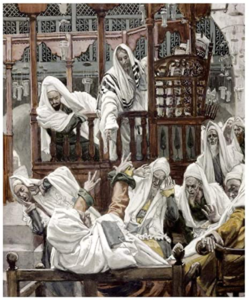
To feel the power of what Jesus says, we have to picture the scene.
He’s standing in the Temple courtyard —
surrounded by religious authorities,
priests in their robes,
men who run the system.
The Sadducees.
They were the religious aristocrats —
a small priestly class who controlled the Temple in Jerusalem.
Wealthy, well-connected, aligned with Rome.
Religion and politics —
for them, it was all one system.
And it worked pretty well for them.
They only accepted the written Torah —
the first five books of Moses —
and since those books don’t mention resurrection or angels,
they didn’t believe in either.
For them, what you see is what you get.
God’s justice is whatever happens — if it happens — in this life.
So when Jesus preaches resurrection,
they hear danger.
Political danger.
Theological danger.
Because resurrection means
God still has surprises they can’t control.
So they come with their clever little riddle —
about a woman who marries seven brothers.
“In the resurrection,” they ask,
“whose wife will she be?”
It’s meant to make hope sound ridiculous.
But Jesus doesn’t take the bait.
He says, “as usual you’re asking the wrong kind of question.”
The resurrection, he says,
isn’t about rearranging the old furniture.
It’s not a continuation of this world’s arrangements —
it’s a transformation of life itself.
And then he quotes their own Torah —
the story of Moses at the burning bush.
God says, ‘I am the God of Abraham’ — not ‘I was.’
If God is their God,
then they are alive to God.
Because to belong to God
is to share God’s life.
And God’s life never ends.
A Theological Debate with Real Consequences
Jesus isn’t just winning an argument here.
He’s taking a stand in one of the great theological battles of his time.
The Pharisees — unlike the Sadducees —
believed that God’s justice must extend beyond the grave, – that wrongs in this life will be eventually put to rights –
that God’s faithfulness doesn’t stop at the cemetery gate.
And here, for once, there is no daylight between Jesus and the Pharisees.
He shares their conviction
that the covenant promise of God cannot be broken by death.
As Bishop Tom Wright says,
resurrection is not simply “life after death,”
but life after life after death —
the full flowering of creation made new.
So this moment in the Temple
is not just a debate about heaven.
It’s a declaration that God’s future is already reaching into the present.
Resurrection is not something we wait for —
it’s something we can live into right now.
Then and Now
It’s easy to leave the Sadducees in the first century,
but their voice still echoes.
You can hear it today whenever people say:
-
- “Be realistic — nothing ever really changes.”
-
- “Power is power — take what you can.”
-
- “Hope is naïve — better to be transactional.”
That voice fills our politics.
It shapes our economy.
It even creeps into our churches.
It whispers:
“The only world that matters is the one you can control.”
“The future belongs to the powerful.”
“Resurrection is just wishful thinking.”
But the God Jesus reveals
won’t fit inside that logic.
The God of Jesus
is the living God —
the One who keeps breaking in,
bringing life where death thought it had the last word.
The God of the Living
When Jesus calls God
“the God of Abraham, Isaac, and Jacob,”
he’s saying something profound about who God is.
If God is their God,
then they are alive to God.
Because God’s faithfulness can’t be interrupted by death.
Resurrection isn’t just about what happens after we die.
It’s what happens whenever God’s life breaks into our dead places:
— when forgiveness replaces bitterness,
— when courage rises to face down fear,
— when love crosses a boundary we thought was final.
That’s resurrection.
That’s the God of the living at work.
Resurrection as Resistance
To believe in resurrection
is to resist despair.
It’s to say that cruelty, injustice, and death
do not get the last word.
It’s to live as if God’s future
is already pressing in on this moment.
And yes —
it’s a dangerous belief.
Because resurrection threatens every order built on fear and violence used as a means of control.
That’s why the Sadducees — then and now —
want to silence it.
Fast Forward to 2025
You don’t have to look far to hear the same old logic being used today:
“People are bad and must be controlled.”
“The poor have only themselves to blame.”
“Immigrants are a threat and so must be expelled.”
“We’re not responsible for climate change, so drill, baby drill.”
“The Church is dying — why bother trying, it’s yesterday’s news?”
And into that weary chorus of constant outrage as distraction, Jesus still speaks:
“God is not God of the dead, but of the living.”
He calls us to live as citizens of that kingdom —
not someday, but today.
To practice resurrection
by daring to hope,
by forgiving, by standing with those the world forgets.
Conclusion — The God of the Living
So what does it mean to say
that God is not the God of the dead, but of the living?
It means that every time we meet despair with courage,
every time bitterness gives way to forgiveness,
every time indifference is replaced with compassion —
resurrection is already happening.
It means faith is not about survival.
Church is not about maintenance.
Resurrection is not escape — resurrection is transformation.
And that transformation begins with us.
That old Sadducean spirit still lingers —
in every system that defends the status quo,
in every voice that says nothing really changes,
in every theology that locks God in the past.
But the living God —
the God of Abraham, Isaac, and Jacob —
the God who raised Jesus from the dead —
will not be managed by fear or cynicism.
To proclaim resurrection
is not to deny death —
it’s to deny its finality.
It’s to trust that love is stronger.
That mercy endures.
That creation still pulses with divine possibility.
It’s to stand in the middle of an anxious, fractured world
and say with quiet defiance:
“The future belongs not to those who manipulate our fear of death,
but to the God who brings life out of death.”
So when you look around at our world —
its exhaustion, its cruelty, its despair —
do not lose heart.
Live as witnesses to the living God.
Practice resurrection
in the small, stubborn acts of love
that make God’s future visible in the present.
For the God of Abraham, Isaac, and Jacob,
the God and Father of our Lord Jesus Christ,
is still the God of the living.
And my friends —this means that however we may be feeling,
God is not done with us yet.
Prayers of the People
22 Pentecost, 9 November 2025
The response to “God of Mercy” is “hear our prayer.”
Loving God, empower us, in our struggle for justice and truth, to challenge one another without bitterness or rancor so that together we may accomplish so much more than any one of us alone.
God of Mercy, hear our prayer.
Lord, remember our nation. In a time when violent words fan violent actions, we pray for the Congress and the courts to uphold the integrity of the Constitution and the protection of those who defend the rule of law.
Lord, our hearts go out to all people affected by the government shutdown. We mourn the loss of essential government services, the absence of which puts all of us at increased risk. We pray earnestly for the courts to grant relief from the administration’s illegal overreach. God of Mercy, hear our prayer.
As random ICE intimidation escalates on our streets, we pray for the courage to stand in solidarity with immigrants and immigrant communities living in increasing fear. God of Mercy, hear our prayer.
We pray for the Church and her life: for Sarah, Archbishop-designate of Canterbury; for Sean, Presiding Bishop, and for Nicholas, our bishop; for Hosam, Archbishop of Jerusalem; for Pope Leo; for Bartholomew, Ecumenical Patriarch. We pray for a witness and commitment to service among all Christian leaders.
God of Mercy, hear our prayer.
In a world of increasingly pressing needs, we pray with renewed energy for a successful outcome to the Hamas-Israeli peace process. We pray for peace with justice to come to the Holy Land.
We continue to pray for a negotiated peace in Ukraine that honors a commitment to Ukrainian sovereignty and future self-determination.
We pray for an alleviation of the enormous suffering of the Sudanese people and an end to civil wars in Sudan, Yemen, and Myanmar. We pray for all forced to flee from their homes and homelands due to the violence of war and threats to life and livelihood.
God of Mercy, hear our prayer.
We remember the Earth and the threat of climate change, praying for the strengthening of emergency services and necessary infrastructure to meet the challenge of climate instability. We remember communities in the path of hurricanes, wildfires, devastating floods, and rising sea levels. God of Mercy, hear our prayer.
We pray for all in need and in trouble: for those whose strength is failing through ill health; whose spirits are flagging through depression; whose determination is being sapped through addiction; that they might know God’s comforting presence and healing.
God of Mercy, hear our prayer.
We remember with love those who have asked for our solidarity in prayer: Beth, Bill, Mary, Ron, Sam, Kenny, Marilou and others we name God of Mercy, hear our prayer.
We pray for our own needs, as well as those nearest and dearest to us, remembering those celebrating birthdays and other anniversaries in the coming week, especially Kaela Hastings, Jude Kostas, Oge, Mora, and Oliver Parker. God of Mercy, hear our prayer.
Surrounded by so great a cloud of witnesses, we remember those we love but see no longer, especially those we name: We pray for all who grieve. God of Mercy, hear our prayer.