
Worship Guide for October 5, 2025
Like TV Guide, but from God! Find the text of the Prayers of the People and Sermon below. Use the buttons provided to find other worship materials.
To see the Worship Guide for other weeks, click here.
To see the Book of Common Prayer online, click here.



Prayers of the People
Seventeenth Sunday after Pentecost, 5 October 2025
The response to “God of Mercy” is “hear us.”
Lord, empower us in our struggle for justice and truth to challenge one another without bitterness or rancor so that together we accomplish so much more than any one of us alone. God of Mercy, hear us.
Lord, remember our nation. In a time when violent words fan violent actions, we pray for the Congress and the courts to uphold the integrity of the Constitution and the protection of those who defend the rule of law.
We continue to mourn the painful spiral of gun violence, especially directed against politicians and other public figures. We pray for the safety of our children, for no one can be safe unless we are all safe. God of Mercy, hear us.
As random ICE intimidation escalates on our streets, we pray for the courage to stand in solidarity with immigrants and immigrant communities living in increasing fear. God of Mercy, hear us.
We pray for the Church and her life: for Sarah Mullally, newly appointed Archbishop of Canterbury; for Sean, Presiding Bishop, and for Nicholas, our bishop; for Hosam, Archbishop of Jerusalem; for Pope Leo; for Bartholomew, Ecumenical Patriarch. We pray for a witness and commitment to service among all Christian leaders.
God of Mercy, hear us.
In a world of increasingly pressing needs, we ask you to forgive our active complicity with Israel’s policy of genocide that is resulting in civilian deaths and the erasure of Palestinian history and culture in Gaza. We also pray for an end to the violent Settler-led ethnic cleansing of Palestinian communities in the West Bank. We pray for peace with justice to come to the Holy Land.
We continue to pray for a negotiated peace in Ukraine that honors a commitment to Ukrainian sovereignty and future self-determination.
We pray for an alleviation of the enormous suffering of the Sudanese people and an end to civil wars in Sudan, Yemen, and Myanmar. We pray for all forced to flee from their homes and homelands due to the violence of war and threats to life and livelihood. God of Mercy, hear us.
We remember the Earth and the threat of climate change, praying for the strengthening of emergency services and necessary infrastructure to meet the challenge of climate instability. We remember communities in the path of hurricanes, wildfires, devastating floods, and rising sea levels.
God of Mercy, hear us.
We pray for all in need and in trouble: for those whose strength is failing through ill health; whose spirits are flagging through depression; whose determination is being sapped through addiction; that they might know God’s comforting presence and healing. God of Mercy, hear us.
We remember with love those who have asked for our solidarity in prayer: Hal, Beth, Bill, Luis, Mary, Ron, Sam, John, Ralph, B.G., Mary Jane, and others we name. God of Mercy, hear us.
We pray for our own needs, as well as those nearest and dearest to us, remembering those celebrating birthdays and other anniversaries in the coming week, especially Abby Marion, Emma Marion, Alexis Skonieczny, Elizabeth Welshman, Elke Moonan, and Carter Buckley. God of Mercy, hear us.
We give thanks for the birth this past Thursday of Tessa Lombardo, daughter of Katie Kleyla and Edward Lombardo, and granddaughter of David and Pat Whitman.
Surrounded by so great a cloud of witnesses, we remember those we love but see no longer, especially those we name. We pray for all who grieve. God of Mercy, hear us.
Celebrant adds a concluding prayer.
Lest We Forget
The Reverend Mark Sutherland
The Seventeenth Sunday after Pentecost, Proper 22
Sermon Recording:
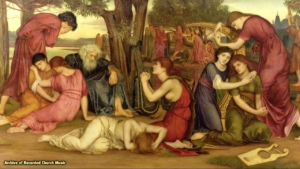
Image: By the Waters of Babylon, by Herbert Sumsion in Ripon Cathedral
In our increasingly visual age, thoughts translate through images. For example, Lamentations 1:1-6 and Psalm 137 offer a remarkably powerful textual pairing. Most of us will choose to read them as text using the Lectionary page insert, yet, for those of us brave enough to put down the insert and allow ourselves to simply listen, the words strike a different kind of effect on us. You may think I’m splitting hairs, but think about the experience of attending a performance of a play. I suppose you might follow along with a copy of the script in your lap. But most of us prefer to raise our heads so we can watch and listen.
There’s reading and then there’s watching and listening; they are not the same kind of experience. In a highly visual age, the evocative power of words heard fills our imagination with visual images. As visual images, Lamentations 1:1-6 and Psalm 137 can be viewed on a split screen as disturbingly complementary images.
Textually, they take the literary form of lament. Although scholars debate the authorship of Lamentations, the weight of consensus in both Jewish and later Christian traditions ascribes or at least associates the authorship with the prophet Jeremiah, also known as the “weeping prophet,” the voice of divine heartbreak. Psalm 137 is also a lament, but one of the human heartbreak experienced by those in exile from all they love.
Developing the idea of words translating into images, when we view Lamentations and Psalm 137 on a split screen, what do we see?
On the left split screen we see the immediate aftermath of Jerusalem’s destruction by Babylon (586 BCE). Lamentations depicts life among those who were too lowly, too poor to be worthy of transportation to Babylon. The tone is one of profound grief and lament over the city’s devastation, depopulation, and humiliation – How lonely sits the city that once was full of people! How like a widow she has become, she that was great among the nations! The poet personifies Jerusalem as a bereaved widow, stripped of her children and her dignity.
On the right side of the split screen, Psalm 137 offers a view set among the exiles now in Babylon. By the waters of Babylon we sat and wept when we remember Zion. The tone is equally anguished – the voice of a deported community remembering Zion from afar, weeping, and vowing never to forget Jerusalem.
Both insist that Jerusalem is not just a place, but the very heart of God’s people. In Lamentations, we see loss and trauma reverberating inwardly as grief and shame. In Psalm 137, we hear loss and trauma reverberating outwardly as longing and rage.
Side by side, these two readings give us a portrait of trauma:
-
- In Jerusalem: emptiness, silence, the unbearable loss of God’s dwelling place.
-
- In Babylon: memory, resistance, a fierce clinging to identity in a hostile land.
Both cry out to God. Both ask: how long can a people endure when the center of their life has collapsed?
But let’s now divide the two-fold split screen into a four-fold split screen. In the upper two quadrants, viewed from left to right, we still see the images depicted in Lamentation and Psalm 137. But now in the lower two quadrants, we add the image of a devastated Gaza beneath that of the ruins of Jerusalem. Alongside and beneath the images of Psalm 137, we place an image of American exile among those mourning the loss of the nation they continue to cherish in their hearts.
On the left of the screen, moving not from left to right but now from top to bottom, we see images of entire neighborhoods reduced to rubble, defenseless people slain in the street, families torn apart, thousands driven from their homes seeking shelter among biblical images of broken wood and stone and more contemporary ones of twisted rebar and shattered concrete.
Our hearts break along with the breaking of God’s heart at Gaza images of grief and death, of three premature newborns forced to share one ventilator because the incubators have been destroyed; of widows and orphans, of families displaced again and again and forced to inhabit the hell envisaged in Lamentations now recreated before our eyes. – How lonely sits the city that once was full of people – words of grief in the city laid waste, echoes of ancient Jerusalem in present-day Gaza.
On the right side of the screen, from top to bottom, our eyes move between images of displacement. From the rivers of Babylon and the refugee camps of Gaza and the West Bank to America’s political disintegration – we hear the exiles cry of anguish: How can we sing the Lord’s song in a foreign land? When will we be able to once more open the doors to the houses we were driven from 75 years before with the keys we’ve passed from generation to generation throughout our long exile? How long, O Lord, can we endure in a nation where the public square, once at least aspiring toward justice, feels captured by cruelty and resentment, and where our institutions fold and our democracy fractures?
We may not have walls of stone toppled like Jerusalem’s, or like Gaza’s shattered rebar and concrete, but we do know what it feels like when moral foundations crumble. When truth is mocked. When compassion is despised and mercy rejected. When neighbors are targeted—immigrants, transgender people, the poor—while the powerful and the corrupt continue in plain sight to enrich themselves. We cry aloud: What has happened to us? Who have we become?
Like the survivors in a ruined Jerusalem, we grieve for what has been lost. Like the exiles by Babylon’s rivers, we pivot between despair and rage. The horrors we see on the four-quadrant split-screen confront us with humankind’s inhumanity. When weeping is over and tears are wiped away, what do these texts—transformed into searing images — ask of us?
What are we to do with our grief and rage as we struggle in the tension between mercy and revenge?
The danger in Psalm 137 is clear: grief can also harden into vengeance. Its final verses cry for revenge of the most brutal kind. In our reading of this psalm, we must resist the strong desire to sanitize it by omitting its final three verses with a false justification that this is not who we are anymore. But do we not know this temptation only too well today, when grievances, real or imagined, find their expression through violent words designed to inflame violent action; when political opponents become enemies to be crushed, not neighbors to be persuaded?
We are Christ’s own. And in Christ, we are called to stop the spiral of vengeance—not by denying grief, but by the transformation of sorrow when we weep honestly with those who weep; when we remember fiercely the values of compassion and justice, even when our rulers mock them; when we witness faithfully that exile is not the end. Ruins are not the last word. For as both Lamentations and Psalm 137 ultimately attest, our God remains faithful to those who refuse to forget Jerusalem.
For our story is resurrection. From rubble, God builds anew. From exile, God leads home as we stand between Lamentations and Psalm 137—between grief for what is lost and hope that refuses to die. In the temptation of despair, we nurture the courage to remain true and to hold fast.
The anguished cry If I forget you, O Jerusalem, becomes our metaphor as we refuse to forget who we are as Christ’s own. We do not have the luxury of surrendering to rage and despair. Let future generations look back at us and say, They remembered. They resisted. And by God’s grace, they rebuilt.
Amen.