
Worship Guide for September 06, 2026
Like TV Guide, but from God! Find the text of the Prayers of the People and Sermon below. Use the buttons provided to find other worship materials.
To see the Worship Guide for other weeks, click here.
To see the Book of Common Prayer online, click here.


Try to Remember
The Reverend Linda Mackie Griggs
15th Sunday After Pentecost Proper 18 Year A
Exodus 12:1-14
Psalm 149
Romans 13:8-14
Matthew 18:15-20
Sermon Recording:
Sermon for September 06, 2026
“How do you remember what you can’t forget?”
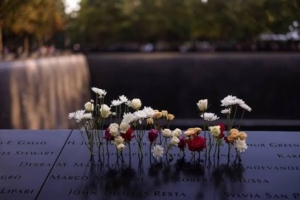
I’ve never heard a more poignant beginning to a September 11 sermon. I was at a church in New York, about 45 minutes from Manhattan; a parish that had intimately known loss as a result of the attacks. Having been in North Carolina in 2001, I had thought I’d known the horror of that day, but moving to the Northeast drew back the veil of my ignorance to reveal the deep, deep grief experienced by the communities tied to the Twin Towers in a way that more distant parts of the country could not know in quite the same way—the connection to so many relatives, friends, and neighbors who traveled into the city routinely and were there on the day the world changed.
“How do you remember what you can’t forget?”
It’s much the same here in Rhode Island—we’re close enough to feel that kind of kinship of mourning and memory. If you’re of an age, you’re imprinted by memory and story—a story that we are still telling: “I remember…”
But what if you’re not “of an age”? What if you were too young to remember or to remember clearly? Or what if you hadn’t even been born yet? Those born in 2002 are now adults and those who came after that approach adulthood fully and painfully aware of the world that emerged from the ashes of the World Trade Center, the Pentagon, and rural Pennsylvania. Generational trauma is a name that we give to how the body remembers what it can’t forget. And it definitely doesn’t help that the world these young people are inheriting is in a very precarious place that in many ways has been formed as a result of the legacy of September 11th. Unlike previous generations, they are not able to say that they believe that they can have it better than their parents. Worse, they hold older generations responsible for the economic, societal, and environmental burden that they must shoulder.
There was a minute after 9/11 when it looked as though we got it; that we realized the value of self-sacrifice and interdependence; of facing tragedy selflessly and as a community.
But it was only a minute. And for a thousand reasons, we squandered it.
“How do you remember what you can’t forget?”
I wonder if we’ve forgotten what we need to remember? Let’s think about that.
“This month shall mark for you the beginning of months…”
It is common in Christian tradition to overlay this story of the first Passover with Christian imagery, to equate the Passover lamb with Jesus, the blood on the doorways as his blood shed for us, and the liberation of Israel to God’s freeing us from the bondage of sin and death. But to see the Passover account as simply the foreshadowing of the Christian story is to do it a tremendous disservice. The liberation of the Israelites stands on its own as it has for the Jewish household of God’s family for millennia; we don’t need to overlay it with another story in order to be fed by it.
And there is much to ponder. The place where we find ourselves with today’s reading is after nine of the ten plagues that YHWH has inflicted upon Pharaoh and the Egyptians. They have endured blood in the rivers, frogs, gnats, flies, pestilence, boils, hail, locusts, and darkness. Egypt is in chaos. Pharaoh keeps changing his mind, saying that he’ll let the people go, and then God hardens Pharaoh’s heart, and then another plague arrives. God is active, vocal, and powerful, and the point is to show Israel just how powerful as the plagues pile up.
And on the other end of today’s story that we’ll hear next week, the miracles and the drama will continue with the flight of the liberated Israelites, the parting of the sea, the death of the pursuing Egyptians, and the presence of God in pillars of fire and cloud.
It’s all quite a spectacle.
Someone should make a movie about it.
But today, in the still center of all of the chaos, we find…what?
A meal. Prepared, served, and eaten in a particular way; a ritual. Shared between neighbors so that everyone will have enough, served with bitter herbs to remember the bitterness of slavery. Eaten quickly—no time for the bread to rise, no time for leftovers. And the lambs’ blood on the doorways—YHWH sees and will act. To liberate. And to kill.
Here, in this still point, is where God’s people learn to remember what they cannot forget.
But this still point is not calm. This is a stillness filled with tension and contradiction, nestled within chaos on every side.
Timothy Adkins-Jones of The Christian Century addresses this, saying that the only way to make meaning from this story is to acknowledge its messiness. There is blood and death even as there is liberation and hope.
“The tension is thick in this text, both in the drama of the moment and in the theological implications. There are so many competing ideas. We have the precision of the sacrifice … paired with the chaos of the moment. The salvation of innocent lives happens because of the murder of some innocent lives. There is the celebration of a feast in the shadow of grief. Israel cheers as Egypt mourns…God’s miraculous work is done in tension as God works in the messiness of the both/and.”
We are meant to wrestle with this. As Adkins-Jones says, there are theological implications to how we read this messy story. Who is the God who emerges from this narrative?
Specifically, how does God feel about the damage God inflicts in this story of hope and liberation, of power and miracle?
Even more to the point, does God grieve for the dead? The first-born Egyptians? The first-born animals? The pursuers drowned when the sea crashed down after the Israelites passed through? Does God mourn their loss?
This is crucial. Because when we read this story, we can fall into a trap of good guys and bad guys and forget that God loved them all into being in the first place. So a God who doesn’t grieve the loss of the dead Egyptians, even as God was the instrument of their destruction—a God who does not grieve this is not a God to whom I can dedicate my heart and my life. I refuse to worship a God of the good guy/bad guy binary; a testosterone-fueled god of Christian Nationalist fantasy. There is a huge difference between a god we’ve created in our own image and the God who created us in God’s image. One rejoices in the carnage of revenge, and the other weeps, knowing that there is no justice without empathy.
In a world of chaos and contradiction, which will we choose to follow?
Is this what we’ve forgotten to remember?
St. Paul bids the church at Rome to remember:
“Owe no one anything, except to love one another; for the one who loves another has fulfilled the law.”
Jesus says it as well in Matthew’s Gospel, although in a delightfully roundabout way. When he instructs his disciples in how to deal with conflict in the community, he says:
“…if the offender refuses to listen even to the church, let such a one be to you as a Gentile and a tax collector.”
A Gentile and a tax collector.
Friends, how did Jesus treat Gentiles and tax collectors? He loved them!
We love one another because God loved us first, and living into that is fundamental to the healing of the world. It also runs counter to our current social/political/cultural narrative, but that doesn’t make it impossible. In fact, it makes it even more vital to the church’s mission.
How do we remember what we cannot forget?
By remembering what we’ve forgotten: That we were created in the image of Love itself and called to live into that fundamental reality in the face of the entrenched forces of chaos, fear, and division that are actively working against it. It is the God of Love who calls us to remember the glimmers of that minute in September 2001—that still point of community and suffering– when we turned toward one another, held one another, and sought to bind up wounds instead of inflicting them. We did it before, and with God’s help may we do it again.