
Worship Guide for September 7, 2025
This is Homecoming Sunday. We will have two services beginning today –
8am – in-person
10am – in-person and online
Today, we will have an ice-cream truck on Orchard Avenue at approximately 11:15.
Like TV Guide, but from God! Find the text of the Prayers of the People and Sermon below. Use the buttons provided to find other worship materials.
To see the Worship Guide for other weeks, click here.
To see the Book of Common Prayer online, click here.


Prayers of the People
Thirteenth Sunday after Pentecost, 7 September 2025
The response to the bidding, “Bountiful Lord”, is “hear us.”
Lord, as we celebrate Homecoming Sunday, bless us as we embark on the activities of a new program year. Empower us to give a good account of the hope and promise that lies within us. Distill in us a stronger sense of your purpose for us. Bountiful Lord, hear us.
Lord, remember our nation. In a time when violent words fan violent actions, we pray for the Congress and the courts to uphold the integrity of the Constitution and the protection of those who defend the rule of law. Bountiful Lord, hear us.
During these days when unconstitutional paramilitary intimidation is being unleashed against innocent individuals, we express our solidarity with immigrants and immigrant communities living with increasing fear. Bountiful Lord, hear us.
We pray for the Church and her life: for Sean, Presiding Bishop, and for Nicholas, our bishop; for Hosam, Archbishop of Jerusalem; for Pope Leo; for Bartholomew, Ecumenical Patriarch. We pray for a witness and commitment to service among all Christian leaders.
Bountiful Lord, hear us.
In a world of increasingly pressing needs, we ask you to forgive our active complicity in the Gaza genocide and the ethnic cleansing of Palestinian communities in the West Bank. We pray for peace with justice to come to the Holy Land.
We continue to pray for a negotiated peace in Ukraine that honors a commitment to Ukrainian sovereignty and future self-determination.
We pray for an alleviation of the enormous suffering of the Sudanese people and an end to civil wars not only in Sudan but in Yemen and Myanmar. We pray for all forced to flee from their homes and homelands by the violence of war and threats to life and livelihood.
Bountiful Lord, hear us.
We remember the Earth and the threat of climate change, praying for the strengthening of emergency services and necessary infrastructure to meet the challenge of climate instability. We remember communities in the path of hurricanes, wildfires, devastating floods, and rising sea levels. Bountiful Lord, hear us.
We continue to pray for sensible gun legislation – that at least our children may no longer be subjected to acts of random violence resulting from the Supreme Court’s distorted reading of the Second Amendment.
Bountiful Lord, hear us.
We pray for all in need and in trouble: for those whose strength is failing through ill health; whose spirits are flagging through depression; whose determination is being sapped through addiction; that they might know God’s comforting presence and healing. Bountiful Lord, hear us.
We remember with love those who have asked for our solidarity in prayer: Jennifer, Hal, Beth, Lawrence and Lee, John, Bill, Ken, Luis, Fernanda, Renato, Luis, and others we name. Bountiful Lord, hear us.
We pray for our own needs, as well as those nearest and dearest to us, remembering those celebrating birthdays and other anniversaries in the coming week, especially Lenny Cambra, Erin Welshman, Jane Lavoie, David Ames, Marie Langlois, and Dwight Phillips.
Bountiful Lord, hear us.
Surrounded by so great a cloud of witnesses, we remember those we love but see no longer, especially Virginia Chase, who died on August 22nd, and those we name: And we pray for all who grieve.
Bountiful Lord, hear us.
Celebrant adds a concluding prayer.
Wrestling
The Reverend Linda Mackie Griggs
The Thirteenth Sunday after Pentecost, Proper 18
Sermon Recording:
“Whoever comes to me and does not hate father and mother, wife and children, brothers and sisters, yes, and even life itself, cannot be my disciple.”
Today’s passage from Luke’s Gospel cannot possibly be more disturbing, or more appropriate, for Homecoming Sunday.
We’re coming home in many ways. We’re beginning a new program year. We’re returning to the nave from the Great Hall after the summer. Some of us are returning from vacation. And of course a lot of folks, teachers and students, are going back to school.
We are glad to be back. We’re looking forward to being together again for worship, fellowship, learning, and ministry. And that’s worth celebrating.
But as luck and the Lectionary would have it, Jesus is asking that we bring to this Homecoming/Back to School Sunday at least a little measure of fear and trembling. Because discipleship is not as easy as we may have come to think.
So therefore, none of you can become my disciple if you do not give up all your possessions.”
(Talk about being thrown in the deep end to start the program year…)
Novelist and poet Wendell Berry, in a 2005 essay, wrote of the difference between faith and confidence. He wrote that it is possible to be faithful while at the same time being beset by hard questions, like “If you had been living in Jesus’ time and had heard him teaching, would you have been one of his followers?” and “Can you be sure that you would keep his commandments if it became excruciatingly painful to do so?”
A faithful life wrestles with the challenges of these questions. The key, according to Berry, is having the courage to face and to be formed by those times when our confidence feels shaky. Or, as the desperate father said to Jesus in Mark’s Gospel, “Lord, I believe, help thou my unbelief.”
So that’s the first step—wrestling. To face the quaking of our hearts in this moment. And knowing that we are not alone with our questions (and dismay), let’s all just acknowledge right here something we’ve always known, but perhaps not really faced: Jesus didn’t make it very easy to be a Christian.
And that is a huge opportunity.
“Now large crowds were traveling with Jesus…”
In a similar passage in Matthew, Jesus addresses a much smaller group—his inner circle of disciples. But here Luke offers a more expansive perspective. Jesus turns to address “large crowds” of people—hundreds? Thousands? We’re left to wonder, what did they expect as they followed him? Healing? Salvation? Political change? Satisfaction of curiosity? What do they think when they hear his words—the drumming of negatives, “does not…cannot…will not…do not…” This teaching is not for the faint of heart. We wonder, how many were left by the time Jesus finished speaking? We wonder (admit it,) “Would I have just ducked my head and returned home?”
Commenters on this passage (responsible ones, anyway,) agree that its message is that the cost of discipleship calls those with ears to hear to wrestle with their current priorities… and lose.
“Whoever comes to me and does not hate…”
Luke has definitely chosen a strong word here, but there is general agreement that he is reflecting usage of the term from early in the Hebrew Bible, where “hate” doesn’t necessarily imply complete negation or renunciation as much as it does deliberate disinterest or detachment. Which is still shocking when applied to one’s family, or even to life itself, especially since it seems to fly in the face of the Fifth Commandment. So the point here is that the Dream of God calls for a radical deepening of how we see family, or even our lives, to the point that our transformed priorities invite us into greater risk for the sake of those beyond our comparatively insular concept of family. This isn’t new—Jesus has talked earlier in Luke about how the Gospel will upend all kinds of conventional relationships, and in Matthew, in the very presence of his mother and siblings, Jesus opened his arms to the crowd and said, “Here is my family!” It was shocking then too. Our families, our very lives, are more expansive in the Kingdom of God, and following Jesus challenges us to live that out. “Who is my neighbor?” Jesus has asked before. Now he asks us, “Who is my family?” “How does my life reflect that?” “What will I risk to live that out?”
Andrew McGowan puts what he calls this “radical confronting demand” in the context of the parables of the builder of the tower and the king going to war. The builder and the king consider well how they should proceed; they do not act on impulse, and they are fully aware of risks and pitfalls. McGowan writes,
“In both cases, the decision is based on considering how everything they have available could be brought to the task, not how they might abandon it.”
Everything they have available.
And of course that included reorienting priorities around possessions—not letting them get in the way of following Jesus. It is indeed a “radical confronting demand” that cannot responsibly be turned into any kind of metaphor; believe me, I’ve tried. The hard (and potentially liberating) truth is that our “stuff” weighs us down and holds us back from the truly abundant life of the Dream of God.
So the questions that emerge are, “What are my resources?” “What are my gifts?” “What are the risks of acting on the Spirit’s nudging…and what are the risks of not acting?”
Deep within today’s text is Jesus’ central point around which all the others revolve, but which has perhaps lost its power to shake us the way it would have done with the first-century audience.
“Whoever does not carry the cross and follow me cannot be my disciple.”
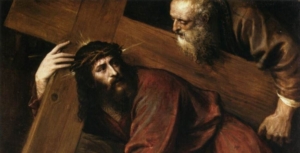
At the time Jesus would have spoken these words, they were not a metaphor. They referred to a method of torture and terror imposed by the Empire to quell dissent and rebellion. Anyone hearing Jesus would have quailed at the image. Anyone called upon to carry his cross, like Simon of Cyrene, would have automatically assumed that they were about to share Jesus’ fate. Martyrs of the faith understood this, including Jonathan Daniels (remembered here a few weeks ago), who took a bullet for a fellow civil rights worker. Not all will share this fate, but following Jesus in true solidarity with the suffering means counting that potential cost. As activist Father Daniel Berrigan said; “If you want to follow Jesus, you better look good on wood.”
McGowan concludes:
“An implication of Jesus’ address to the crowds is that not all of them (or us) will decide they really can build this tower, or fight this battle. He thus refuses the possibility that he or his message can be something just incremental, a form of “spirituality” that can be added to enhance a life that remains bent on other priorities, whether personal, familial, or national. He will not be harnessed to any agenda to make us more efficient consumers, or leaders, or even family members, independently of him. Following him means giving all that up.”
And so on this Homecoming/Back to School Sunday, we wrestle. How will the wrestling form us and shape our lives? If you go back and review the sermons for the past few weeks, you’ll see that they include pointed reminders; of God’s call to forms of resistance to principalities and powers, of God’s call to the church to be a force for mercy and liberation, of God’s call to us to expand our Eucharist Table beyond our doors. All of these are wide-open opportunities to shape and orient our common life as disciples of Jesus. What is the Spirit saying to us—what is Her invitation?
This is really nothing new. We just need to remember the call of our Baptism; marked as Christ’s own forever. It is not just a comfort for our fear and trembling, it’s a challenge; to be bold for the Dream of God.